
- Home
- Products
- Company
- Solutions
- Advantages
- Blog
- Contact
- Hot
Views: 0 Author: Site Editor Publish Time: 2026-09-08 Origin: Site


Tungsten presents unique metallurgical challenges on the production floor. Its exceptionally high ductile-to-brittle transition temperature dictates that drawing temperature fundamentally controls the final mechanical properties of the wire. Standard steel is often cold-drawn at true room temperature. Tungsten requires a completely different thermal approach. Selecting the wrong drawing process carries severe operational and financial risks. You face excessive die wear, frequent wire breakage, and poor surface finishes. You might fail to meet strict industry tolerances required for medical devices or semiconductor testing equipment. We will compare the cold-drawn process against hot-drawn systems. This analysis establishes a framework to evaluate both processes based on target diameter, tensile strength requirements, and production scalability.
Temperature Definitions: In tungsten metallurgy, "cold drawing" refers to drawing below the recrystallization temperature (not room temperature), which is critical for work-hardening and achieving high tensile strength.
Process Alignment: Hot drawing is essential for initial breakdown passes and thicker diameters, while cold drawing is mandatory for fine, ultra-fine, and high-precision finishing.
Cost vs. Yield: Hot drawing requires higher energy input for heating but reduces drawing force due to increased malleability; cold drawing demands robust tooling and premium lubrication but yields superior surface finishes and tighter dimensional tolerances.
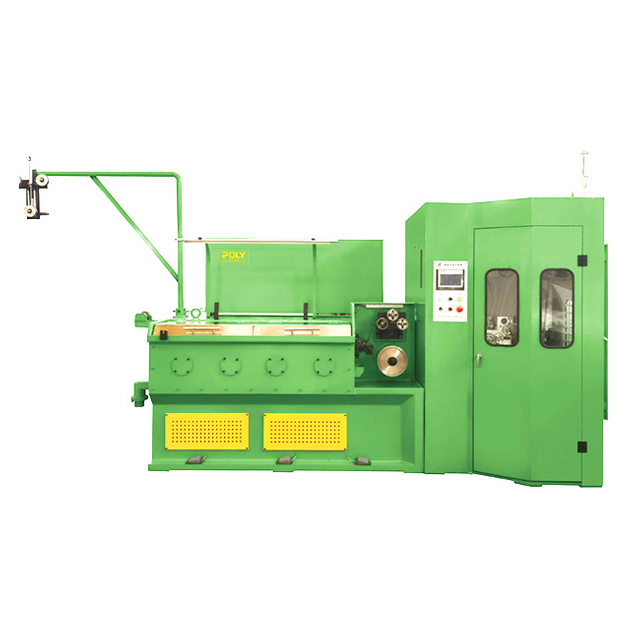
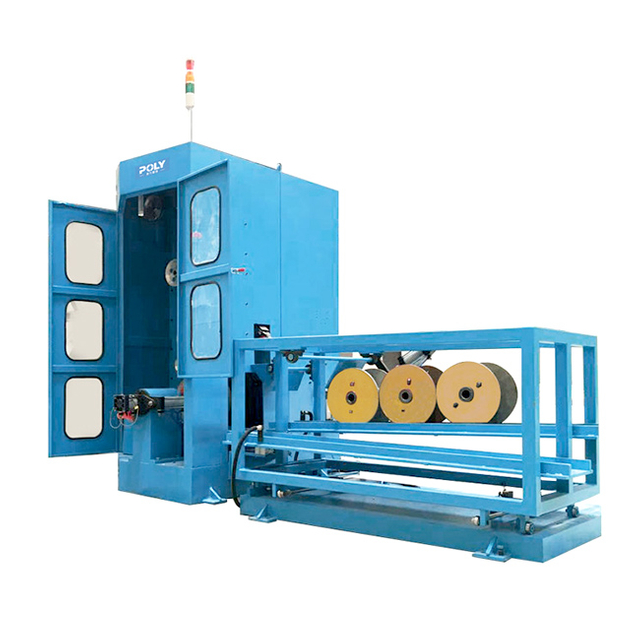
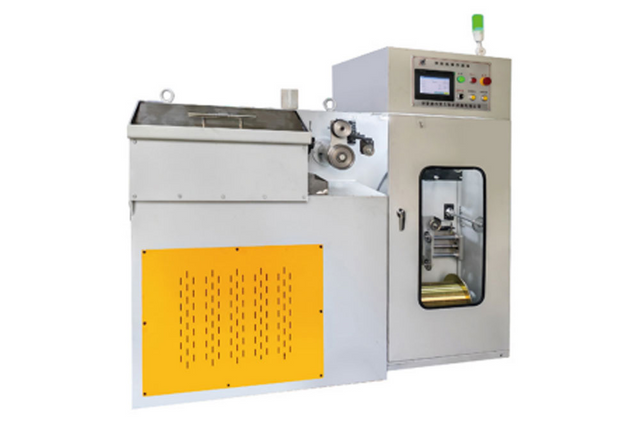
System Integration: Modern production often requires a hybrid approach, utilizing a comprehensive tungsten wire drawing machine series to transition wire from upstream swaging/rolling, through hot breakdown, to cold finishing.
Tungsten behaves differently than common industrial metals like steel or copper. Its ductile-to-brittle transition temperature sits well above room temperature, often ranging between 300°C and 400°C depending on its prior thermomechanical history. You cannot draw tungsten at true ambient temperatures without causing catastrophic failure. The metal simply shatters under tension. Operators must apply heat to maintain structural integrity during deformation.
We must establish a technical baseline for processing this refractory metal. Hot drawing means processing the metal above its recrystallization point. This high thermal state maintains malleability during heavy reduction passes. Cold drawing means processing below the recrystallization point. This specific thermal zone induces strain hardening. Even "cold" drawing for tungsten happens at elevated temperatures compared to ambient factory conditions. The terminology refers to the metallurgical state of the metal, not the thermometer reading in the facility.
Advanced wire drawing technology fundamentally alters the crystalline structure of the metal. The drawing process transforms equiaxed grains into elongated, interlocking fibrous structures. This fibrous alignment provides the exceptional longitudinal strength required for fine wire applications. Each successive pass through the die compresses and stretches these grains further. Managing the temperature ensures these grains elongate smoothly rather than fracturing under the immense drawing force.
When the metal passes through the reduction zone, the slip planes within the crystal lattice slide against each other. If the temperature is too low, these planes lock up. This locking causes micro-voids that eventually lead to wire breaks. Proper thermal management keeps the lattice mobile enough to deform but rigid enough to retain the induced strength. Understanding this balance separates successful production runs from scrap-heavy failures.
A hot-drawn tungsten wire drawing machine integrates robust heating elements directly before the drawing die. Systems typically utilize gas burners, induction coils, or electrical resistance heaters. These components soften the tungsten rod or thick wire immediately prior to reduction. The metal enters the die in a highly malleable state, ready for aggressive diameter reduction.
Hot drawing handles the initial breakdown passes. You must use this method when reducing sintered ingots or thick swaged rods down to intermediate diameters. The raw metal lacks the inherent ductility for cold reduction at this stage. Attempting to bypass the hot drawing phase will destroy both the wire and the drawing dies. The swaging process that precedes drawing leaves the metal dense but still requiring heavy thermal assistance to flow through a die profile.
Evaluating this process requires looking at specific features and their outcomes. High material malleability lowers the required drawing force. This reduces immediate mechanical strain on the machine's capstans and blocks. You lower the mechanical cost of reduction. However, high temperatures increase the risk of rapid surface oxidation. You must use protective atmospheres like hydrogen or forming gas. Specialized colloidal graphite-based lubricants are mandatory to protect the die at these extreme temperatures. The graphite bakes onto the wire, forming a protective barrier against the carbide die.
Operators face significant limitations regarding yield and precision. Maintaining uniform temperature control presents a constant challenge. The core of a thick tungsten rod heats at a different rate than its surface. If the core remains too cool, it resists deformation, causing internal stresses that manifest as center-burst defects. Operators must calibrate the heating zone length and the wire transit speed to ensure complete thermal penetration before the metal hits the die approach angle. Thermal fluctuations cause inconsistencies in the metal's expansion and contraction. These variations lead to wider dimensional tolerances. Hot drawing simply cannot match the micrometer-level precision of cold finishing.
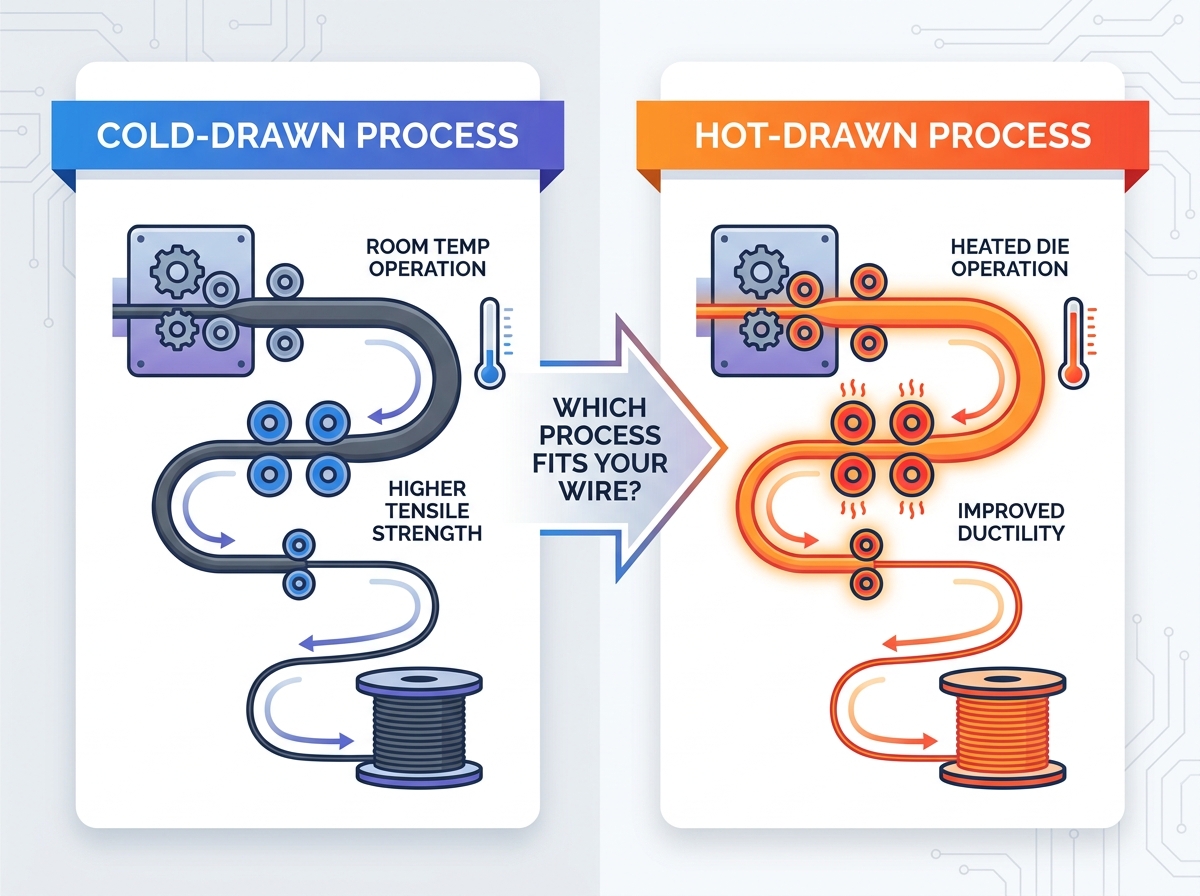
The cold drawing process pulls intermediate tungsten wire through progressively smaller dies. You operate at lower temperatures strictly below the recrystallization point. Manufacturers use heavy-duty tungsten carbide dies for larger sizes. Natural or synthetic polycrystalline diamond (PCD) dies handle the ultra-fine wire reduction. The machine relies on high motor torque to pull the less malleable metal through the reduction zone.
Advanced tooling shapes the final product to exact specifications. Standard round dies handle basic diameter reduction. Turk's head configurations allow manufacturers to modify the wire's size and form into flat or shaped profiles. This versatility is required for specialized electrical and mechanical components. The die profile itself—comprising the bell, approach angle, bearing length, and back relief—must be engineered specifically for tungsten's high friction coefficient.
Cold drawing induces severe work hardening. This mechanical deformation significantly increases the tensile strength, elasticity, and fatigue resistance of the finished tungsten wire. The interlocking grain structure reaches its maximum density. The wire becomes incredibly strong along its longitudinal axis. The capstans on a cold-drawn tungsten wire drawing machine require precise speed synchronization. As the wire elongates through each die, its linear speed increases. The machine's control system must adjust the rotational speed of each subsequent block to maintain constant back-tension. Too much tension snaps the wire; too little causes slippage and surface scoring.
The process strips away heavy oxide layers left behind by previous hot working stages. You achieve a bright, highly polished finish. This clean surface is essential for downstream plating, coating, or ensuring optimal electrical conductivity. A smooth surface also prevents premature fatigue failure in dynamic applications. Liquid lubricants provide boundary lubrication, flushing away microscopic debris and dissipating the intense heat generated by mechanical deformation.
Cold-drawn outputs serve high-value, precision-critical industries. Ideal applications include medical guidewires, semiconductor probe pins, lighting filaments, and critical aerospace components. These sectors demand exact dimensional tolerances and flawless surface aesthetics. Natural diamond dies often provide the ultimate surface finish, while PCD dies offer superior wear resistance for longer production runs.
Comparing these systems directly reveals their distinct roles in the manufacturing lifecycle. Hot drawing relies heavily on initial hot-rolling or swaging processes to prepare the raw ingot. Cold drawing relies entirely on the successful, defect-free output of the hot-drawn phase. You cannot cold draw a rod that has internal voids or severe surface cracking. The upstream quality dictates the downstream success.
Surface quality and dimensional tolerances differ drastically. Cold drawing achieves micrometer-level precision. The standard deviation in wire diameter remains exceptionally tight. Hot drawing exhibits a higher standard deviation due to thermal expansion and the thick layer of graphite lubricant required during the pull. You must account for this graphite layer when measuring the intermediate wire diameter.
Tooling wear profiles present different maintenance challenges. Hot-drawn systems suffer from thermal degradation of dies. Maintenance teams must constantly monitor and repair heating apparatuses, gas lines, and burner nozzles. Cold-drawn systems face extreme abrasive wear on diamond or carbide dies due to higher drawing forces. They require premium liquid lubricants and rigorous filtration systems to keep the drawing fluid clean.
Energy consumption shifts based on the process mechanics. Hot drawing consumes massive amounts of electricity or gas for continuous heating. The facility must support high-capacity power drops and ventilation hoods. Cold drawing requires higher mechanical power. The motors must generate immense torque to pull the work-hardened wire through the reduction dies, shifting the energy load from thermal to kinetic.
Evaluation Criteria | Hot-Drawn System | Cold-Drawn System |
|---|---|---|
Input Material | Sintered ingots, thick swaged rods | Intermediate wire (previously hot-drawn) |
Operating Temperature | Above recrystallization point | Below recrystallization point |
Primary Goal | Heavy diameter reduction, breakdown | High tensile strength, exact tolerances |
Die Material | Tungsten carbide | Tungsten carbide, Natural Diamond, PCD |
Lubrication Type | Colloidal graphite (baked on) | Liquid drawing oils, synthetic fluids |
Surface Finish | Oxidized, graphite-coated, rough | Bright, polished, clean |
Energy Demand | High thermal energy (heating elements) | High mechanical energy (motor torque) |
Tooling Wear | Thermal degradation, oxidation | Abrasive friction, mechanical stress |
Assess your starting material and final required wire gauge before investing in new equipment. Thick rods require hot reduction. Fine wire demands cold drawing. If your facility processes raw sintered ingots down to lighting filaments, you need both capabilities. You must match the machine's pulling force and thermal capacity to your specific reduction schedule. Overloading a machine designed for fine wire with thick rods will burn out the motors.
You must integrate these machines seamlessly with existing production lines. Upstream integration involves connecting the drawing process to swaging and rolling equipment. Downstream integration includes continuous annealing, ultrasonic cleaning, and precision spooling systems. A complete tungsten wire drawing machine series bridges the gap between raw ingots and finished spools. Proper floor layout ensures smooth material handling between the hot breakdown area and the cold finishing cleanroom.
Evaluate modular machine designs to ensure long-term scalability. Modular blocks allow you to add or remove drawing passes as product specifications evolve. You can adjust the number of reduction steps without overhauling the entire line. This flexibility future-proofs your production floor against changing market demands. Modern equipment features programmable logic controllers (PLCs) that monitor die temperature, motor torque, and wire tension in real-time. This data allows operators to identify wearing dies before they cause a wire break.
Manage die wear aggressively in cold drawing operations. Implement specific die geometries tailored for tungsten, focusing on optimal approach angles and bearing lengths. Install robust cooling systems and advanced lubrication filtration. Clean liquid lubricant extends die life and prevents microscopic wire scratching during high-friction passes. A single piece of debris in the die approach can score thousands of feet of wire before detection.
Control oxidation risks during hot drawing by maintaining strict protective environments. Use inert or reducing gas atmospheres around the heating zone. Ensure proper industrial ventilation for graphite lubricants. Airborne graphite dust poses respiratory hazards and can short-circuit electrical equipment. Operator safety and product integrity depend on strict environmental controls.
Operators require extensive technical expertise to run these lines efficiently. They must manage delicate tension control to prevent wire snapping. Threading procedures require precision, especially with ultra-fine diameters. Thermal hazards in hot drawing demand rigorous safety protocols. Invest heavily in continuous operator training to minimize downtime and scrap rates.
Establish a strict die inspection schedule using laser micrometers to detect wear before it impacts wire roundness.
Implement a closed-loop filtration system for cold drawing lubricants to remove microscopic tungsten particles.
Calibrate heating elements on hot drawing lines weekly to prevent uneven thermal expansion in the wire core.
Train operators on emergency tension-release protocols to minimize equipment damage during a wire break.
Standardize the wire re-pointing and re-threading procedures to reduce machine downtime after a failure.
Hot and cold drawing processes are complementary rather than strictly competitive. The choice depends entirely on the specific segment of the manufacturing process you are upgrading. Understanding the metallurgical demands of tungsten ensures you select the correct thermal and mechanical approach for your target diameter. If you process raw rods or thick wire over 1mm, prioritize a hot-drawn system. If you manufacture fine wire under 0.1mm requiring high tensile strength and a bright finish, a cold-drawn machine is mandatory.
Take the following steps to finalize your equipment selection and optimize your production line:
Request sample drawing tests from equipment manufacturers using your specific tungsten grade to verify motor torque capabilities.
Audit your current die-maintenance capabilities to ensure you can support in-house diamond die polishing and resizing.
Evaluate your facility's ventilation and utility capacity to handle protective gas atmospheres and high-amperage power drops safely.
Map out your required diameter reductions to determine the exact number of modular drawing blocks needed for your specific workflow.
A: Steel is typically cold-drawn at true room temperature. Tungsten has a much higher ductile-to-brittle transition temperature. Therefore, "cold drawing" tungsten actually occurs at elevated temperatures. Operators must apply heat to prevent shattering, but keep temperatures strictly below the recrystallization point to induce necessary work hardening.
A: Advanced cold-drawn machines using synthetic or natural diamond dies can reduce tungsten wire to ultra-fine diameters. Production lines routinely achieve diameters below 0.01mm (10 microns). This extreme precision is essential for manufacturing medical guidewires and semiconductor testing components.
A: Tungsten is extremely brittle at room temperature. Applying the high tensile forces required for drawing at ambient temperatures will cause the wire to fracture and snap immediately. The metal must be heated to maintain sufficient ductility during the mechanical deformation process.
A: Drawing below the recrystallization temperature elongates the grain structure into interlocking fibers. This specific work-hardening process significantly increases the wire's longitudinal tensile strength and fatigue resistance. Drawing above this temperature prevents work hardening, keeping the metal softer.
A: Hot-drawn machines primarily use heavy-duty tungsten carbide dies. These dies can withstand the extreme temperatures and heavy reduction forces required during the initial breakdown passes of thick tungsten rods. Diamond dies are avoided here because high heat causes diamond to degrade and graphitize.
A: Preventing breakage requires strict tension control, perfectly aligned die geometries, and premium liquid lubrication. Operators must ensure the wire is free of surface defects from upstream processes. Continuous monitoring of motor torque and back-tension prevents the wire from exceeding its ultimate tensile strength during the pull.



 English
 简体中文
简体中文
