
- Home
- Products
- Company
- Solutions
- Advantages
- Blog
- Contact
- Hot
Views: 0 Author: Site Editor Publish Time: 2026-09-18 Origin: Site


The demand for ultra-fine, high-tensile tungsten wire is accelerating across high-stakes industries. Miniaturization in electronics, precision requirements in surgical robotics, and the need for thinner kerf in silicon wafer slicing drive this shift. Achieving sub-micron tolerances and pristine surface finishes in pure tungsten and tungsten alloy wire requires overcoming the metal's inherent brittleness and extreme hardness. The fundamental working principle—applying precise tensile force to pull wire through a series of progressively smaller dies—must be flawlessly executed. Improper drawing mechanics lead to micro-cracking, frequent wire breaks, and unacceptable yield losses. Selecting the correct cold-drawn tungsten wire drawing machine is a major capital expenditure. This guide provides a technical evaluation framework to align machine specifications with the rigorous demands of medical, electronic, and diamond-saw wire production.
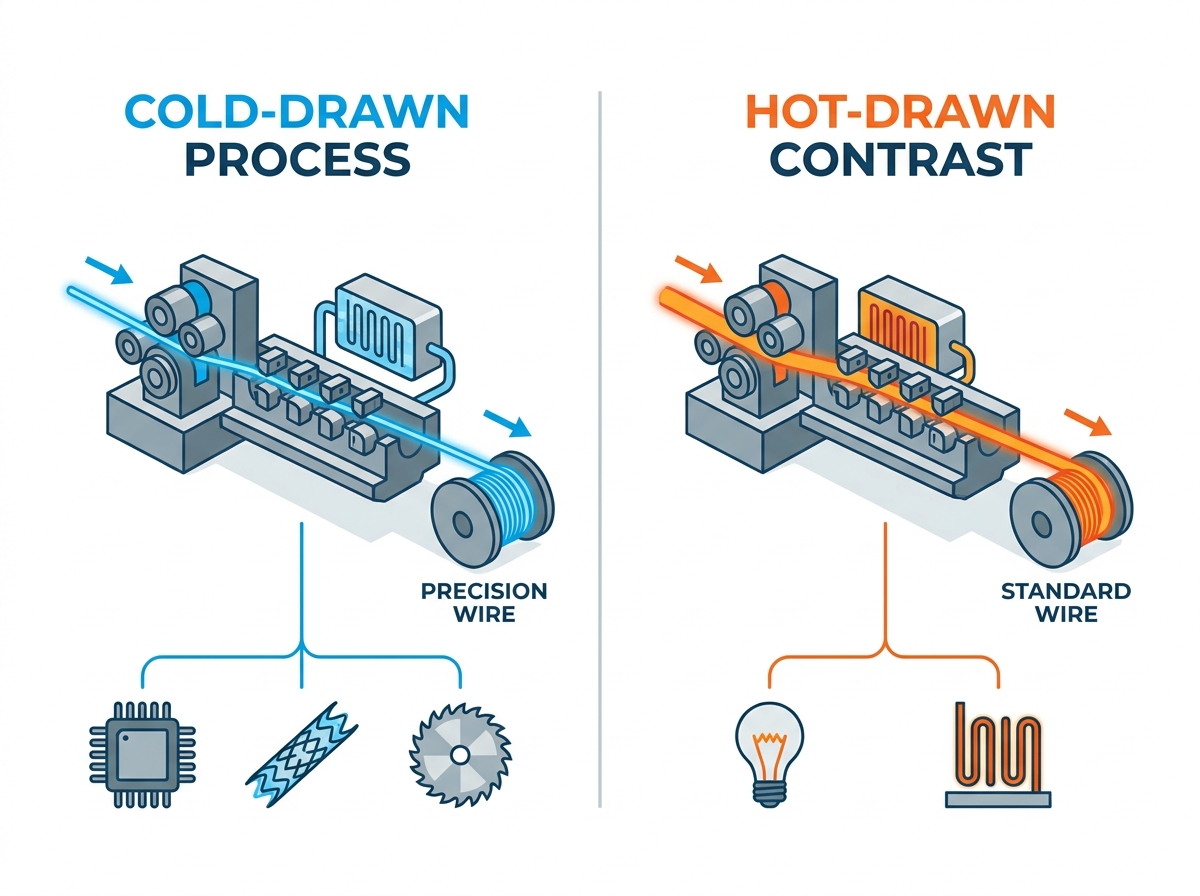
Process Transition: Cold drawing is strictly reserved for the final stages of tungsten wire reduction; understanding the exact handover point from a hot-drawn tungsten wire drawing machine is critical for maintaining grain structure.
Application-Specific Tolerances: Equipment requirements vary drastically between medical wire manufacturing (prioritizing surface finish and biocompatibility) and diamond-saw wire production (prioritizing ultimate tensile strength).
Die Selection is Paramount: The choice between natural diamond, synthetic polycrystalline diamond (PCD), tungsten carbide, and specialized split wire drawing dies directly dictates machine tension settings, cooling requirements, and overall uptime.
Tungsten possesses the highest melting point of all pure metals. It remains exceptionally brittle at room temperature during initial processing stages. These physical properties necessitate elevated temperatures for initial diameter reduction. A hot-drawn tungsten wire drawing machine utilizes gas-air mixing heating systems operating between 900 and 400 degrees Celsius. This intense heat makes the thick tungsten rods ductile enough for heavy deformation. The hot drawing phase establishes the initial wire geometry and begins the process of grain elongation.
A metallurgical shift occurs as the diameter decreases to specific thresholds, typically around 0.3mm to 0.1mm depending on the alloy. The process must transition to cold drawing techniques. Cold drawing occurs at room temperature or slightly elevated temperatures well below the recrystallization point of the metal. This specific thermal environment refines the fibrous grain structure. It maximizes the ultimate tensile strength in pure tungsten and enhances the mechanical properties of complex tungsten alloys. Cold drawing equipment focuses entirely on precision mechanics rather than heavy thermal application. The operational footprint shrinks significantly compared to hot drawing lines. Energy requirements shift from massive heating elements to high-torque, highly synchronized servo motors driving the capstans.
Cold reduction induces severe work hardening within the tungsten matrix. As the wire passes through each die, the metal grains elongate and compress tightly together. This structural change increases tensile strength dramatically. However, it simultaneously increases the inherent brittleness of the wire. The material loses its residual ductility with every successive pass. Managing this delicate balance requires exceptional equipment precision on the shop floor.
Operators must establish multi-pass drawing sequences. Low-reduction-ratio passes become an absolute necessity. You cannot force heavy diameter reductions in a single step like you might with softer metals such as copper or aluminum. The machine must safely apply tensile force across multiple capstans. This gradual approach prevents the induction of internal shear stress. Excessive shear stress causes immediate wire fracture, bringing the entire production line to a halt. The drawing machine must maintain absolute synchronization between passes. Even minor tension spikes will snap work-hardened tungsten instantly. Engineers calculate specific draft schedules to optimize the reduction per die, usually keeping area reduction below 15 percent per pass. This careful planning ensures continuous production without catastrophic line breaks.
The medical device sector demands uncompromising quality control. Success criteria include absolute dimensional consistency across kilometers of wire. Operators must achieve zero surface defects during production. Microscopic scratches can harbor dangerous pathogens or cause tissue damage during surgical procedures. High fatigue resistance is non-negotiable for navigating human vasculature without failure. These stringent requirements dictate specific equipment capabilities.
Machines dedicated to medical wire manufacturing require ultra-precise capstan synchronization. Advanced inline laser micrometers provide real-time diameter monitoring. These sensors detect micron-level deviations instantly, feeding data back to the control system. The equipment must utilize specialized lubrication systems. These lubricants cannot contaminate the final wire surface. Biocompatibility standards prohibit the use of certain heavy industrial drawing oils. Cleanroom-compatible machine enclosures prevent airborne particulate contamination from settling on the wire before it enters the die. The tension control must react in milliseconds to prevent surface galling, ensuring the wire remains perfectly smooth.
The photovoltaic and semiconductor industries rely heavily on diamond-coated cutting wire. This wire slices massive silicon ingots into ultra-thin wafers. The primary success criterion here is extreme ultimate tensile strength. The wire must withstand massive high-speed slicing tension without stretching or breaking. It also requires a very specific surface topography. A slightly rougher, highly controlled texture optimizes subsequent diamond grit plating processes, allowing the abrasive particles to adhere securely.
A dedicated diamond-saw wire drawing machine series features high-speed continuous drawing capabilities. These machines operate at significantly higher velocities than medical wire lines. Heavy-duty vibration dampening is a structural requirement. High speeds generate harmonic resonance that can shatter fine tungsten wire. The equipment utilizes robust spooling mechanisms. These take-up units handle extremely long, continuous lengths, often exceeding hundreds of kilometers per spool. They must wind the wire without introducing micro-bending stresses. Precision traversing guides ensure perfectly level spooling, preventing tangles during the payoff stage at the wafer slicing facility.
Tungsten wire serves as the backbone for various electronic components. Applications include traditional filaments, vacuum tube grids, and semiconductor test probe pins. Success criteria focus heavily on electrical conductivity preservation. The wire must maintain exact electrical resistance per meter. Thermal stability under electrical load is required to prevent component failure in the field.
Machine requirements prioritize exceptionally clean drawing environments. Micro-contamination alters the electrical resistance of the wire, leading to rejected batches. Precise back-tension control prevents localized stretching. Localized stretching reduces the diameter in isolated spots, creating electrical hot spots that burn out prematurely. Some manufacturing lines require integration with inline annealing modules. These modules relieve internal stresses before final spooling, restoring a degree of ductility. The capstans must feature specialized ceramic or coated surfaces to prevent static buildup and minimize friction outside of the dies.
Tension control dictates the ultimate success of ultra-fine tungsten drawing. Engineers must evaluate slip versus non-slip drawing mechanics. Slip machines allow the wire to slide slightly on the capstan. This compensates for elongation during the drawing process but can cause surface abrasion. Non-slip machines maintain a zero-slip grip on the wire. Zero-slip mechanics offer superior tension control for brittle alloys. They prevent surface scratching caused by capstan friction, making them ideal for high-end applications.
Modern equipment relies on multi-axis servo motors. These motors drive each capstan independently, eliminating the mechanical slop found in older belt-driven systems. Dancer arm feedback loops provide physical tension measurement. The wire routes over a movable pulley connected to a low-friction pneumatic cylinder. As tension changes, the dancer arm moves. A Programmable Logic Controller (PLC) reads this movement and adjusts motor speeds instantly. This closed-loop regulation prevents wire breakage at micro-gauges. It ensures the continuous application of stable tensile force. High-resolution encoders track capstan rotation down to fractions of a degree, providing the PLC with exact speed data.
Machine compatibility with different die materials is an evaluation metric you cannot ignore. The drawing stage and specific alloy dictate the required die technology. The machine must feature versatile die holders. These holders must accommodate various casing dimensions and cooling requirements.
Die Material | Primary Application Stage | Machine Integration Requirements | Operational Advantages |
|---|---|---|---|
Tungsten Carbide | Thicker gauges, initial cold passes | High torque capacity, robust die cooling | Cost-efficiency, handles high friction coefficients |
Natural Diamond | Ultra-fine finishing passes | Extreme tension precision, micro-filtration | Flawless surface finish, exact dimensional tolerances |
Polycrystalline Diamond (PCD) | Intermediate to fine passes | Rigid die alignment, high-pressure lubrication | Extreme wear resistance, extended service life |
Split Wire Drawing Dies | Complex profiles, frequent threading | Adjustable clamping mechanisms | Easier threading, operational flexibility |
Tungsten carbide dies handle the thicker gauges effectively. They offer excellent cost-efficiency for early reduction stages. The machine must handle higher friction coefficients when using carbide. Diamond dies become necessary for ultra-fine cold drawing. Natural and PCD diamonds offer extreme wear resistance. The machine must provide precise die alignment. Misalignment causes uneven die wear and wire ovality. Advanced tooling includes tungsten carbide diamond split wire drawing dies. These combine extreme wear resistance with operational flexibility. They ensure easier threading for complex profiles and reduce downtime during setup.
Friction generates significant localized heat at the die interface. This occurs despite the process being classified as cold drawing. Effective thermal management prevents die degradation and wire surface burning. You must assess the machine's cooling infrastructure thoroughly before installation.
Evaluate submerged drawing versus spray lubrication systems. Submerged systems pull the wire through a bath of lubricant. This provides excellent cooling and boundary layer protection, ensuring the die remains fully flooded. Spray systems target high-pressure lubricant directly into the die cone. Fluid filtration capabilities demand strict scrutiny. Tungsten drawing generates microscopic abrasive fines. These fines circulate within the lubrication fluid. The filtration system must remove these particles completely. Failure to filter fines results in severe wire scoring and premature die failure. Centrifugal separators, magnetic filters, and sub-micron filter cartridges are mandatory components for a healthy drawing line.
Modern manufacturing requires comprehensive data oversight to maintain yield rates. Review the necessity of inline flaw detection systems. Eddy current sensors detect internal voids and cracks that are invisible to the naked eye. Optical sensors monitor surface integrity and diameter variations in real-time. These systems trigger immediate machine stops upon defect detection, preventing the spooling of hundreds of meters of scrap wire.
Discuss SCADA integration with the equipment vendor. Supervisory Control and Data Acquisition systems track critical metrics across the entire production floor. They monitor die wear trends across thousands of kilometers of drawn wire. This data enables predictive maintenance scheduling. Operators replace dies before they produce out-of-spec wire. Batch traceability is a strict requirement for ISO-certified medical applications. The system logs tension, speed, and diameter data for every spool. This creates a permanent quality record for end-users, proving compliance with tight engineering tolerances.
Throughput directly influences production capacity and facility output. However, maximum speed often compromises quality. You must analyze the trade-off between meters per second and surface integrity. Pushing a machine beyond its optimal velocity increases friction exponentially. This degrades the lubricant boundary layer. The wire makes direct contact with the die surface. This contact causes galling, microscopic surface tearing, and rapid die wear.
Medical and electronic applications demand strict surface finishes. Operators must run machines at conservative speeds to guarantee quality. Diamond-saw wire production tolerates slightly rougher surfaces. Therefore, those specific machines can operate at much higher velocities. Evaluate the machine's vibration characteristics at maximum speed. Heavy cast-iron frames absorb harmonic vibrations better than welded steel. Stable frames permit higher speeds without sacrificing surface quality or causing wire breaks.
Evaluate the operational strategy of your facility. Determine the need for machine flexibility versus dedicated production lines. A highly specialized machine maximizes efficiency for a single product. It features optimized capstan sizes and fixed draft schedules. This limits the ability to process different alloys or diameters, but it excels at high-volume, continuous runs.
Modular machines offer significant retooling capabilities. Operators can adjust draft schedules via the HMI. They can swap die holders to accommodate different casing sizes. This flexibility allows one machine to process various tungsten alloys and wire profiles. However, modular machines often feature a larger footprint. They may lack the extreme top-end speed of dedicated equipment. Weigh your product mix against these equipment capabilities. High-mix, low-volume facilities benefit from modular architectures. High-volume commodity producers require dedicated, high-speed lines to meet demand.
Environmental instability introduces severe production risks on the shop floor. Temperature fluctuations alter the viscosity of drawing lubricants, changing how they flow into the die cone. Airborne particulates contaminate ultra-fine wire surfaces, causing inclusions during the drawing process. These factors compromise overall product quality and increase scrap rates.
Install machines in climate-controlled environments to maintain consistent ambient temperatures year-round.
Utilize cleanroom-adjacent protocols for medical and electronic wire production to minimize dust.
Specify enclosed machine architectures with positive pressure ventilation to keep contaminants out of the drawing zone.
Implement strict gowning procedures for operators handling fine wire spools.
Monitor humidity levels to prevent oxidation on exposed wire surfaces between drawing passes.
Ultra-fine tungsten drawing requires highly skilled operators. Improper threading through the series of dies causes immediate failures upon startup. Incorrect die sequencing alters the reduction ratio dangerously, overloading the capstan motors. Mishandling of ultra-fine wire leads to catastrophic line breaks and hours of downtime.
Prioritize machines equipped with automated threading assist mechanisms to reduce manual handling.
Utilize split die compatibility to simplify the threading of complex profiles and thicker starting gauges.
Specify intuitive HMI interfaces with visual draft schedule confirmations to prevent sequencing errors.
Secure comprehensive vendor training programs covering metallurgy, machine mechanics, and troubleshooting.
Implement standardized operating procedures for die inspection, cleaning, and replacement.
Cold drawing relies entirely on the quality of the incoming material. Inconsistent feed wire causes immediate failures in the cold-drawing stage. Diameter variations from the hot drawing process jam the first cold die. Surface oxidation acts as an abrasive, destroying expensive diamond tooling within minutes.
Establish strict quality control gates between hot and cold drawing processes to catch defects early.
Ensure compatible spooling and payoff systems to prevent wire tangling and erratic back-tension.
Implement inline ultrasonic cleaning before the wire enters the first cold die to remove residual oxides.
Measure the tensile strength of incoming spools to verify proper annealing and grain structure.
Maintain a direct feedback loop between hot drawing and cold drawing operators to correct upstream issues quickly.
Request detailed capability studies from OEMs focusing on tension stability across micro-reduction passes.
Mandate sample drawing runs using your specific tungsten alloy grades to verify surface finish and dimensional accuracy.
Conduct a thorough audit of the vendor’s die management and cooling system designs to ensure adequate filtration.
Verify the integration capabilities of inline laser micrometers with your existing quality control software.
A: These machines achieve sub-micron capabilities, typically drawing wire down to 0.01mm or less. Success depends heavily on die quality and the extreme wear resistance of the tooling. Multi-pass tension control prevents breakage at these microscopic gauges. Advanced servo synchronization is mandatory for reaching these ultra-fine diameters without inducing shear stress.
A: Hot drawing utilizes gas-air mixing heating systems operating between 900 and 400 degrees Celsius. It relies primarily on tungsten carbide dies for heavy initial reduction of thick rods. Cold drawing operates at room temperature. It uses natural or PCD diamond dies and focuses on high-precision tension control for final finishing passes.
A: Diamond dies provide superior wear resistance and a long service life. They hold exact dimensional tolerances across massive production runs. Natural and PCD diamonds create a flawless, scratch-free surface finish. This pristine surface is a critical requirement for meeting strict medical biocompatibility standards and preventing pathogen harboring.
A: Diamond-saw wire requires high-tension, zero-slip drawing mechanics. This aggressive tension management maximizes the ultimate tensile strength of the wire. The wire must become rigid and strong enough to withstand high-speed silicon slicing without snapping or stretching under heavy operational loads.
A: Breakage prevention requires low reduction ratios per pass, typically under 15 percent. Machines must use highly synchronized servo-driven capstans. Dancer arm feedback loops adjust tension in milliseconds to prevent spikes. Optimal die lubrication reduces friction. These combined elements safely manage the applied tensile force on brittle tungsten alloys.
A: Yes, modular systems accommodate both materials. Carbide dies handle thicker, upstream passes where friction is high and cost-efficiency is needed. Diamond or specialized split wire drawing dies handle the final cold-drawn micro-passes. The machine's die holders must feature adjustable geometries to secure both die types properly.
A: Tungsten possesses extreme hardness compared to copper. This requires specialized, high-pressure boundary lubricants that withstand massive shear forces without breaking down. The system also demands aggressive, sub-micron filtration. This filtration removes abrasive tungsten fines that would otherwise score the wire and destroy expensive diamond dies instantly.



 English
 简体中文
简体中文
