
- Home
- Products
- Company
- Solutions
- Advantages
- Blog
- Contact
- Hot
Views: 0 Author: Site Editor Publish Time: 2026-11-16 Origin: Site


Every high-speed wire drawing line eventually faces a critical finish line. The efficiency of your wire extrusion or drawing operation heavily depends on its final packaging method. Misaligning the output format with your factory goals leads to downstream tangling. It causes excessive changeover downtime and frequently compromises wire properties.
Deciding between continuous bulk packaging and precision-layered winding requires careful operational analysis. You must look beyond the machine itself. Evaluating the entire lifecycle of the finished wire is essential. Consider the journey from your factory floor to the end-user's pay-off process. A poorly chosen format will bottleneck your entire production run.
This guide breaks down the structural differences and implementation trade-offs between winding methods. We explore the technical evaluation criteria you need to integrate the right equipment into your facility. You will learn how output formats directly dictate your overall line efficiency. Ultimately, you will discover which system best aligns with your specific wire materials and downstream demands.
Production Continuity: Drop coilers allow for non-stop line operation by depositing wire continuously into static carriers, minimizing machine downtime compared to single-bobbin systems.
Downstream Usability: Bobbin take-up systems provide superior tension control and twist-free pay-off, making them mandatory for high-speed, precision downstream applications (like stranding or fine extrusion).
Physical Trade-offs: Drop coiled wire introduces inherent torsion (twist) during packaging, whereas a wire winding machine preserves the wire's natural cast and helix at the cost of requiring active spool management.
CapEx vs OpEx: Bobbin systems often require higher operational overhead for spool logistics, while drop coilers demand larger floor footprints for carrier staging and accumulator systems.
A production line is only as fast as its final collection point. Manufacturers often treat packaging as an afterthought. However, the output format defines your true operational speed. It acts as the ultimate gatekeeper for product quality.
You should never view a wire take up machine as a simple collection bin. It serves as the final quality-control checkpoint in your plant. This equipment directly impacts wire tension and surface integrity. It also determines packaging density. If the machine applies incorrect tension, it can stretch or deform the product. Poor density leads to unstable packages. These unstable packages pose safety risks during transport. They also cause massive headaches during the final unwinding stage.
You must frame your equipment decision around the next step in the value chain. Ask yourself where the wire goes after it leaves the machine. Will you sell it directly to construction end-users? Will operators feed it into a high-speed nail-making machine? Perhaps they will send it to a planetary strander for cable assembly.
Each downstream application demands specific characteristics. A nail-making machine handles bulk coils easily. A high-speed strander requires perfectly straight, tension-controlled wire. Ignoring these downstream dependencies guarantees future production bottlenecks.
Wire manufacturing features a fundamental tension. Operators want to maximize line speed. Meanwhile, they must manage the inevitable downtime required to swap packages. Removing a full package and inserting an empty one takes time.
Continuous systems try to eliminate this pause. Batch systems accept the pause but focus on package quality. Balancing this throughput against changeover time drives your equipment selection. High-volume, low-margin wire demands maximum uptime. High-margin, delicate wire justifies the slower changeover process.
For operations prioritizing sheer volume, bulk packaging presents an attractive solution. Continuous coiling systems handle massive weights. They reduce operator intervention and keep the line moving. However, they introduce specific mechanical realities.
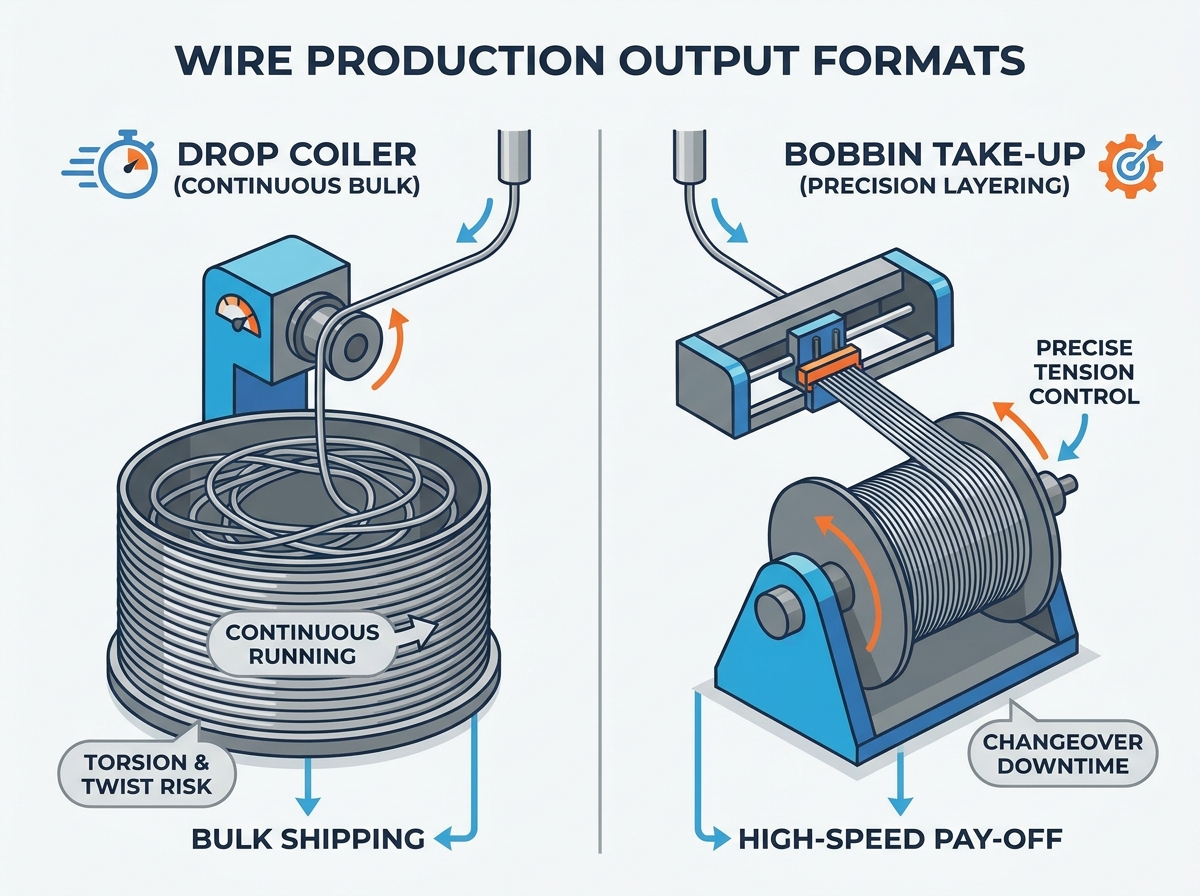
A dead block coiler operates on a simple but effective principle. The main capstan draws the wire through the final die. The machine then continuously drops the wire in a rosette pattern. This wire falls into a tubular carrier, a stem, or a large drum. The block itself remains stationary (hence "dead block"). A flyer arm rotates around it to guide the wire downward. This continuous dropping motion allows the machine to deposit wire without stopping the main drawing process.
The business case for a wire coiler centers heavily on uptime and labor reduction. Facilities producing standard carbon steel or fencing wire rely heavily on these metrics.
Continuous Running: Many systems incorporate overhead accumulators. These devices hold excess wire temporarily. The line keeps running while operators remove full carriers. This effectively pushes your machine uptime near 100%.
High Payload Capacity: These machines package massive weights. Carriers often hold between 1,000kg and 3,000kg of product. Larger packages mean fewer changeovers. They also drastically reduce transport handling on the factory floor.
Best Practice: Always match your rosette pattern settings to the wire gauge. A perfectly tuned pattern ensures maximum density and prevents the loops from collapsing.
Despite their volume advantages, these systems carry inherent mechanical trade-offs. You must evaluate these risks against your customer requirements.
Torsion and Twist: By design, every loop dropped introduces one full twist into the wire. You cannot avoid this physical reality. This twist is unacceptable for applications requiring a dead-straight pay-off.
Density and Tangling: Poorly tuned rosette patterns cause severe problems later. If the loops shift during transport, they interlock. This causes "snagging" when the end-user attempts to pull the wire out at high speeds. Snags lead to instant wire breaks.
When product quality supersedes pure volume, manufacturers turn to spooling. Winding wire onto a structured core provides unmatched control. This control is vital for sensitive materials.
A bobbin take-up system operates dynamically. The wire is actively wound onto a rotating spool. A motorized traversing guide moves back and forth across the spool's width. This guide ensures operators achieve perfectly parallel layers. The machine constantly adjusts its rotational speed. As the spool fills up, its diameter increases. The motor must slow down to maintain a constant linear drawing speed.
Facilities handling telecommunications cables or delicate alloys rely entirely on spooling. The physical protection offered by the spool flanges is invaluable.
Zero Torsion: The system winds the wire in its natural state. The spool rotates to collect the material. This ensures a high-speed, twist-free payoff in subsequent processes.
Precise Tension Control: The system maintains strict tension. This is essential for fine gauges or delicate materials like copper or fiber optics. You must avoid stretching or surface marring at all costs.
Best Practice: Regularly inspect your traversing guides. Worn guides cause overlapping layers. An overlapped layer will trap the wire during the final payoff process.
Spooling systems demand higher operational attention. They introduce logistical challenges you rarely see in continuous bulk packaging.
Changeover Downtime: A standard single-spooler requires you to stop the production line. Changing a full bobbin halts your output. You can bypass this by investing in expensive dual-spoolers featuring auto-crossover technology.
Spool Logistics: Active winding requires a massive inventory of empty spools. You must store them. You must maintain them. Damaged flanges cause immediate wire traps. Furthermore, you face return logistics to bring empty spools back to your facility.
Comparing these output formats directly helps clarify the decision. No single solution dominates the market. Instead, specific operational constraints dictate the ideal choice.
Comparison of Output Formats
Evaluation Criteria | Bulk Coiling | Spool Winding |
|---|---|---|
Wire Twist | Adds 1 twist per loop | Zero twist introduced |
Continuous Operation | Yes (near 100% uptime) | Requires auto-crossover or line stop |
Ideal Material | Heavy, rigid steel wire | Fine, soft copper or telecom wire |
Package Weight | Up to 3,000kg+ | Limited by spool capacity/handling |
The physical stiffness of your material often makes the choice for you. Heavy or rigid wire strongly favors bulk packaging. Materials like high-carbon steel or agricultural fencing tolerate twisting. They also benefit from the massive bulk requirements.
Conversely, soft wire demands a wire winding machine. Copper, fine aluminum, and telecommunications cables strictly require tension control. If you drop-coil soft copper, the material will stretch under its own weight. The loops will collapse and tangle.
You must compare the sustained throughput of continuous coiling against spooling. Bulk systems offer a sustained, unyielding output. They run for hours without a pause. Standard spool systems feature a start/stop nature. Unless you invest heavily in dual-spoolers, your line efficiency drops every time a spool fills up. For ultra-high-volume commodity wire, continuous operation usually wins.
You must evaluate how the end-user extracts the wire. To understand the full picture of drop coiler vs bobbin take-up, look at dynamic pay-off speeds. Spool systems allow for incredibly high-speed unwinding. The spool simply rotates.
Bulk coils require a flyer pay-off or a vertical pull system. Pulling wire vertically out of a drum can be speed-limited. Centrifugal forces become dangerous at high speeds. Tangling risks multiply if the end-user attempts to pull the wire faster than the rosette pattern allows.
Selecting an output format changes your physical factory layout. It dictates your material handling strategy. It also redefines your safety protocols.
Bulk continuous machines require immense height clearance. The dead block sits high above the floor. You also need massive staging areas. Operators must stage empty carriers and remove full ones using forklifts. This creates a wide, active traffic zone.
Spooling systems require significant linear floor space. The traversing mechanism spans the width of the machine. Furthermore, you need heavy-duty lifting equipment. Cranes or motorized pintles are mandatory to load and unload massive steel reels safely.
Technology changes the labor equation for both methods. Modern spoolers feature robotic loading systems. Arms can automatically eject full spools and insert empty ones. This removes the operator from the hazard zone entirely. However, this automation drives your CapEx significantly higher.
Bulk machines offer a lower-tech approach to high-volume handling. They rely heavily on gravity and simple accumulators. While CapEx is lower, labor risks are present. You require rigorous safety protocols around the accumulator zones. Operators face significant danger near the cutting zones when transitioning wire to a new carrier.
Neither packaging system is universally superior. The choice hinges strictly on the wire's physical properties. You must also satisfy the end-user's pay-off requirements. Ignoring either factor creates costly inefficiencies.
If continuous uptime and massive bulk shipping are paramount, lean toward continuous coiling. It dominates heavy steel applications. If downstream precision is required, specify a spooling system. Zero-twist pay-off and surface protection are non-negotiable for soft, fine materials.
Take immediate action by auditing your current changeover downtime. Calculate exactly how many minutes you lose per shift. Request sample packaging from OEM vendors. Test this sample wire on your downstream pay-off equipment. Confirm full compatibility before committing capital to a new line.
A: Yes, some manufacturers design tandem lines with inline diverters. This setup allows operators to route wire to either a coiler or a spooler depending on the production run. However, this hybrid approach requires high initial CapEx and a significantly larger floor footprint.
A: A bobbin take-up system is vastly superior. Fine copper requires precise tension management. This precision prevents elongation and surface work-hardening. Continuous coilers cannot guarantee this level of tension control.
A: Yes, because the wire is coiled without rotating the package, one twist is added per loop. However, this is easily neutralized. The end-user can utilize a flyer pay-off system. This device pulls the wire over the top of the carrier, effectively untwisting it as it pays out.
A: Speeds vary heavily by wire gauge. Spool systems can easily exceed 30 m/s for fine wire. Continuous coilers typically operate at lower speeds, generally between 10-20 m/s. This depends on the dead block diameter and your cooling capabilities, as the wire must be sufficiently cooled before dropping.




 English
 简体中文


