
- Home
- Products
- Company
- Solutions
- Advantages
- Blog
- Contact
- Hot
Views: 0 Author: Site Editor Publish Time: 2026-10-19 Origin: Site


Upgrading a wire drawing line often reveals a critical bottleneck at the spooling stage. Manufacturers push for higher throughput, only to find their existing equipment holding them back. Choosing the wrong take-up system inflates capital expenditures unnecessarily. It also cripples overall equipment effectiveness through relentless changeover downtime. Every minute spent swapping spools destroys production efficiency and impacts the bottom line.
At the bottom of the funnel, the decision goes beyond simply spooling wire. You must match line speed constraints, scrap reduction goals, and available floor space with the correct mechanical approach. An improper choice leads to constant operator fatigue and material waste.
We provide a direct, evidence-based framework for evaluating single versus dual spoolers. You will learn to balance maintenance realities and production throughput seamlessly. This guide helps you finalize procurement specifications confidently. Follow these insights to maximize operational efficiency and safeguard your manufacturing profit margins.
Production Continuity: Double bobbin setups eliminate line-stop changeovers, making them mandatory for high-speed, continuous drawing and extrusion lines.
CapEx vs. OpEx: Single bobbins require lower initial investment and simpler maintenance, but incur hidden costs in machine downtime and ramp-up/ramp-down material scrap.
Automation ROI: Upgrading to an automatic bobbin changing system is typically justified only when running fine to medium wire gauges at speeds where manual changeovers create severe production bottlenecks.
Implementation Reality: Continuous systems require sophisticated tension control (dancers/accumulators) and rigorous operator training to prevent crossover faults during the switch-over phase.
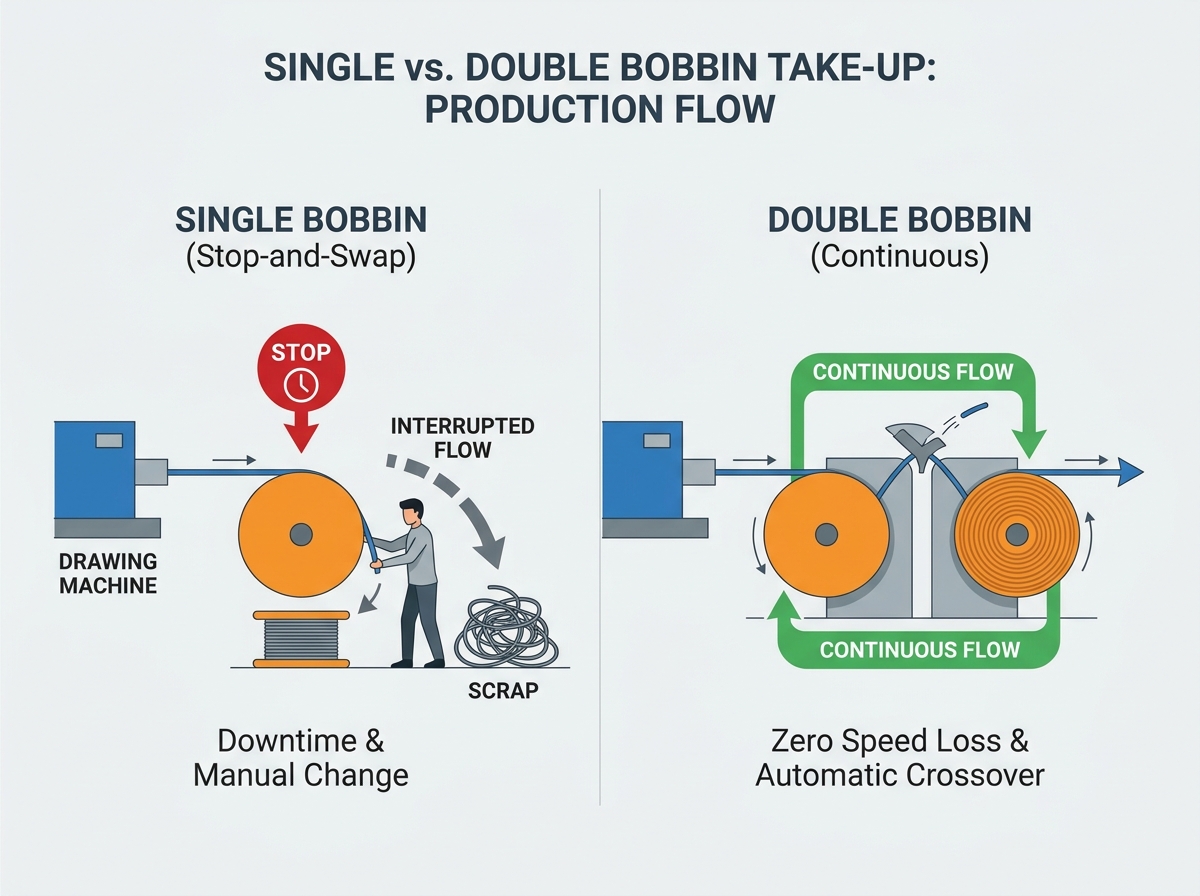
You face a fundamental mechanical choice when specifying new equipment. Single spoolers operate on a rigid stop-and-swap reality. Operators must halt the entire line when a spool fills. They manually cut the wire, remove the heavy full spool, and load an empty one. Dual systems offer a continuous, zero-speed-loss crossover mechanism. They switch spools automatically without decelerating the main line. This stark mechanical contrast defines the single vs double bobbin take up machine debate.
Throughput takes a massive hit during manual changeovers. Ramp-down, manual swapping, and ramp-up phases eat into productive time rapidly. These extreme speed fluctuations also impact your drawing dies and capstans. Sudden deceleration alters wire tension drastically across the machine. This tension shift pulls wire unevenly through the final die. It often creates inconsistent diameters and compromises the final surface finish.
Yield rates directly reflect these operational interruptions. Frame your evaluation around hidden material waste. Stopping a drawing line for a single bobbin change guarantees some level of scrap. Out-of-tolerance wire gauges frequently occur during the critical deceleration and acceleration windows. Continuous systems eliminate these wasteful speed variations completely. They maintain steady tension and speed, ensuring consistent wire quality from the first meter to the last.
Single spoolers still hold significant value in specific manufacturing environments. Heavy wire gauges, rod breakdowns, and thick cables often demand them. These thick materials resist rapid bending and high-speed cutting. Such processes run at inherently lower speeds anyway. Batch processing remains standard here because order volumes often match a single large spool capacity perfectly. You might also process specialty alloys requiring frequent quality checks. In these cases, intermittent stops do not severely damage your overall throughput.
These simpler systems offer strong financial and operational justifications. Consider these core advantages:
They require a significantly lower initial capital expenditure, preserving your budget for upstream drawing blocks.
Mechanical complexity remains low, featuring fewer drives, pneumatic cylinders, and complex sensors.
Fewer moving parts mean your maintenance team faces far less preventative maintenance overhead.
You can also mitigate some downtime drawbacks using clever engineering. Add high-capacity accumulators to your single-spool line. These vertical or horizontal devices store wire temporarily during a bobbin changeover. Accumulators utilize a series of pulleys to hold a buffer length. They bridge the gap, keeping the main drawing machine running at a reduced speed while the operator swaps the spool. However, they impose strict limits. If operators struggle with a stuck spool, the accumulator reaches maximum capacity quickly. The line must then stop entirely, defeating the buffer's purpose.
Upgrading to continuous spooling requires a clear return on investment. You must define your ROI threshold accurately before committing. At what exact line speed does downtime cost exceed the dual-spooling equipment premium? Fine to medium wire gauges usually cross this financial threshold very quickly. High drawing speeds turn manual changeovers into severe production bottlenecks. When a spool fills every twenty minutes, operators simply cannot keep up.
Zero-downtime mechanics drive the immense value of an automatic bobbin changing drawing machine. These systems rely on a robust snagger and flying cut-off mechanism. The rapid changeover sequence follows a strict, automated order:
The drive system accelerates the empty bobbin to perfectly match the current line speed.
A mechanical transfer arm guides the running wire toward the empty spool flange.
The high-speed flying shear cuts the wire instantaneously.
The snagger mechanism grabs the fresh wire end securely, initiating the new wind without dropping tension.
This highly reliable process transfers wire at full production speed. It also optimizes your facility's labor resources. Automatic changeovers shift operator responsibilities significantly. Workers step away from physically demanding, repetitive manual spool swaps. Instead, they handle supervisory quality control, monitor sensor dashboards, and manage logistics.
Energy efficiency presents another compelling, often overlooked benefit. Massive induction motors consume extreme energy spikes during startup. Single systems force these heavy motors to repeatedly stop and restart. Continuous systems keep these large rotating masses moving steadily throughout the entire shift. This reduction in electrical demand spikes lowers your monthly utility bills noticeably.
Selecting the right equipment requires rigorous evaluation of several technical factors. Tension control stands as a primary concern for continuous operation. The system must manage wire tension perfectly during the instantaneous bobbin switch. Properly integrated dancers prevent wire breaks and drawing die damage. They use pneumatic cylinders to apply precise counter-force. They absorb mechanical shock and maintain steady pulling force. A reliable high speed take-up system for wire drawing depends entirely on this dancer synchronization.
Traverse accuracy dictates the structural quality of the finished spool. You must evaluate the precision of the laying mechanism closely. Modern servo-driven ball screws provide perfectly level-wound bobbins. This mechanical perfection becomes critical for downstream unspooling in extrusion or stranding lines. Poorly wound spools cause tangles, overlaps, and breaks during later processing steps.
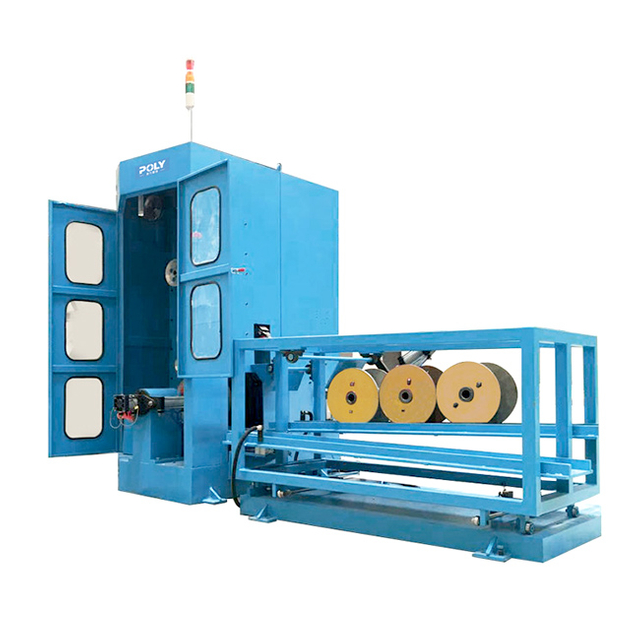
Physical space requirements demand careful floor planning. Address your footprint and layout constraints early in the project. Double bobbin systems are inherently longer and significantly heavier. You must verify concrete foundation requirements before installation begins. Ensure the new dual unit integrates physically with your existing drawing blocks and safety cages.
Control system compatibility guarantees smooth, safe operation. The take-up Programmable Logic Controller (PLC) must handshake seamlessly with older equipment. It needs to communicate flawlessly with the existing drawing machine's master control. Perfect speed synchronization relies entirely on this digital integration.
System Capabilities Overview
Operational Feature | Single Bobbin System | Double Bobbin System |
|---|---|---|
Line Speed Loss | 100% stop required for every manual changeover | 0% loss; continuous operation maintained |
Scrap Generation | High volume (occurs during ramp-up/ramp-down) | Minimal volume (steady state maintained) |
Space Requirement | Compact footprint; easy facility integration | Large footprint; requires heavy foundation |
Capital Investment | Low initial purchase cost | High initial purchase cost |
Labor Intensity | High physical demand on operators | Low physical demand; supervisory focus |
Double bobbins do not offer a magical silver bullet for poor production practices. They introduce complex points of failure into your line. The skeptical engineering view highlights these vulnerabilities clearly. Cutting knives dull over time and require constant sharpening. Mechanical transfer arms require precise alignment to hit the snagger target. Dual motor drives double the chance of an unexpected electrical fault.
You must address these maintenance realities head-on to succeed. Implement strict, non-negotiable preventative maintenance schedules. The automatic changeover mechanism must never fail during production. A failed high-speed transfer results in catastrophic wire tangles. Operators then spend hours manually clearing sharp, tangled wire from the machine guards.
Calculate your long-term operational expenses over a five to ten-year lifecycle. Balance the higher maintenance and spare parts costs against recovered revenue. Dual systems cost more to maintain annually in parts and specialized labor. However, they drastically increase your machine uptime percentages. More continuous uptime means more sellable product at the end of every shift. This massive increase in daily output usually dwarfs the higher maintenance burden.
Your final decision rests on matching mechanics to your specific operational realities. Use this simple decision matrix to guide your team. Choose a single bobbin system for heavy wire gauges and lower running speeds. It fits tight capital budget constraints and simple maintenance profiles perfectly. Choose a double bobbin system for fine or medium wire. It excels in continuous high-speed drawing environments. It helps combat high labor costs and easily meets strict corporate scrap reduction targets.
Take a proactive next step today. Audit your current changeover downtime logs for the past quarter. Quantify exactly how many productive hours you lose weekly to manual swaps. Then, request a customized OEE impact projection from your preferred machinery manufacturer. Base your final specification commitment on hard data and actual floor realities, not assumptions.
A: Retrofitting is extremely difficult and rarely cost-effective. Single systems lack the foundational footprint for dual shafts and transfer arms. Furthermore, upgrading the older PLC software to handle flying cuts and dual-dancer synchronization requires extensive engineering. Replacing the entire take-up unit is usually the safer, more reliable choice for manufacturers.
A: Fine to medium gauges benefit most from continuous spooling. Flying shears face strict physical limitations when cutting thick rod or heavy wire at high speeds. Cutting massive cross-sections requires excessive mechanical force, which destabilizes the machine frame. Heavy gauges run slower anyway, making manual single-bobbin changeovers much more manageable.
A: Modern control systems feature instant fault-handling protocols. If a break occurs, dancer sensors immediately detect the sudden loss of tension. The PLC triggers a synchronized emergency stop across the entire drawing line. Integrated mechanical brakes engage to prevent the broken wire from whipping and causing operator injury or machine damage.
A: Yes, dimensional consistency is vital for automation. Automated clamping and transfer mechanisms rely on strict bobbin tolerances. Warped flanges or inconsistent bore diameters cause clamping failures. Such failures disrupt the transfer arm alignment, leading to missed cuts and massive wire tangles. You must invest in high-quality, standardized bobbins.



 English
 简体中文


