
- Home
- Products
- Company
- Solutions
- Advantages
- Blog
- Contact
- Hot
Views: 0 Author: Site Editor Publish Time: 2026-09-04 Origin: Site


Producing fine tungsten wire involves high stakes. Micro-fractures, surface imperfections, and wire breakage directly erode production yields and compromise end-use applications in medical devices, semiconductor components, and aerospace technology. Scaling down to ultra-fine diameters presents a massive engineering challenge. You must maintain strict dimensional tolerances while preserving surface integrity. Tungsten possesses extreme tensile strength and high frictional resistance. It behaves very differently from highly ductile metals like copper or low-carbon steel. Standard wire drawing equipment designed for conventional alloys simply fails here. It cannot prevent brittleness or stop catastrophic wire breakage. You need a highly specialized solution to handle these extreme mechanical demands. This guide provides a technical framework for evaluating machine specifications, die compatibility, drum wheel synchronization, and operational scalability to ensure high-yield, continuous production.
Precision is Non-Negotiable: Mold base accuracy, stable ring performance, and wire guide wheel alignment are critical; even microscopic deviations increase friction and cause catastrophic wire breakage in fine tungsten.
Die Material Dictates Yield: The choice between Polycrystalline Diamond (PCD), CVD, and Tungsten Carbide dies must align perfectly with the machine’s tension control capabilities to hit exact operating target diameters.
Process Sequencing Matters: Understanding the exact transition point from a hot-drawn tungsten wire drawing machine to cold-drawn processing is vital for maintaining material ductility and surface finish.
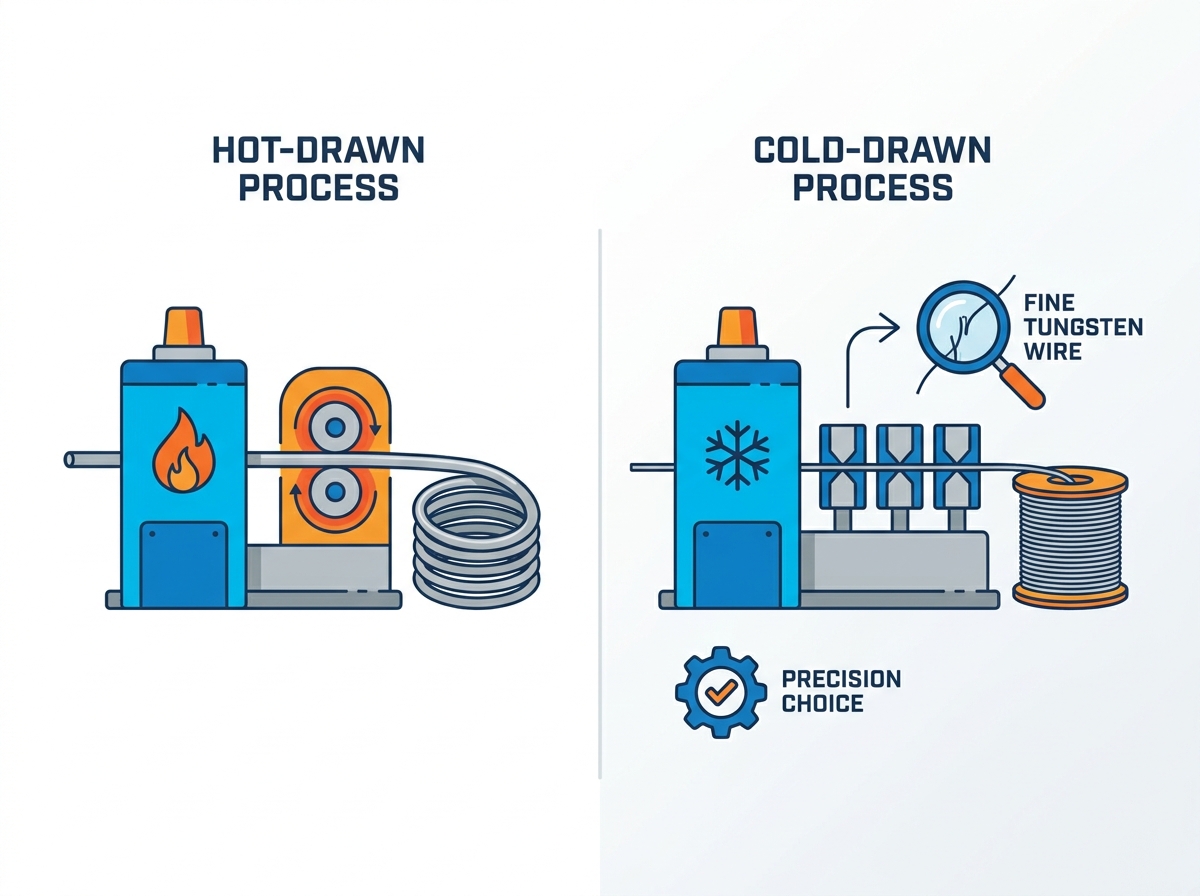
Cold drawing occupies a highly specific stage in the tungsten wire manufacturing lifecycle. It typically occurs only after initial heavy reduction processes are complete. Manufacturers deploy cold drawing specifically for ultra-fine diameters. At this stage, the material requires exact sizing and a pristine surface finish. You cannot achieve these final properties using high-temperature methods.
We must compare the mechanical and thermal realities of different systems. A hot-drawn tungsten wire drawing machine operates under extreme heat. It often utilizes gas-air mixing heating to maintain temperatures between 900℃ and 400℃. This heat is necessary for thicker tungsten alloys. It prevents severe brittleness during massive cross-sectional reductions. Hot drawing relies heavily on cemented carbide dies to handle the thermal load. The elevated temperature increases the ductility of the tungsten rod, allowing for aggressive draft reductions without fracturing the crystalline structure.
Cold drawing operates at room temperature. It focuses on final sizing rather than bulk reduction. The absence of external heat changes the mechanical dynamics completely. The material exhibits higher yield strength. It becomes more susceptible to cleavage fracture if mishandled. However, cold drawing achieves superior surface finish. It locks in the exact mechanical properties required for high-tech applications. The cold working process elongates the grain structure of the tungsten along the drawing axis. This fibrous grain structure significantly enhances the longitudinal tensile strength of the finished wire.
When tungsten undergoes cold drawing, the grains elongate significantly. This elongation creates a highly fibrous microstructure. This fibrous structure is what gives fine tungsten wire its incredible longitudinal strength, making it suitable for applications like surgical robotics and semiconductor wire bonding. However, this same fibrous structure makes the wire highly susceptible to transverse splitting. If the drawing die applies uneven pressure due to misalignment, the wire will split down its length. This metallurgical reality dictates every aspect of machine design. You cannot simply pull the wire; you must guide it with absolute concentricity.
Success in fine wire production relies on strict baseline metrics. Target diameter consistency is paramount. You must measure this consistency in microns. Even a one-micron deviation can ruin a semiconductor bonding wire. Tensile strength retention is another critical metric. The drawing process must work-harden the wire without pushing it past its ultimate tensile limit. Finally, you must track acceptable breakage rates per kilometer of wire. High breakage rates destroy production efficiency and waste raw material.
To achieve these metrics, operators must carefully calculate the area reduction per pass. In cold drawing tungsten, draft reductions typically range from 8% to 15% per die. Exceeding a 15% reduction in a single cold pass generates excessive friction. This friction leads to rapid work hardening and immediate wire failure. You must distribute the total required reduction across multiple consecutive dies. This multi-pass approach requires a machine capable of handling complex tension zones between each capstan.
Tension control dictates the success or failure of fine tungsten drawing. You must evaluate slip versus non-slip wire drawing technology. Slip machines allow the wire to slide slightly on the capstan. This sliding compensates for elongation differences between drawing drafts. It requires highly specialized lubricants to prevent surface scratching. Non-slip machines accumulate wire between blocks. They offer better surface protection but demand incredibly complex synchronization.
For ultra-fine tungsten, multi-axis tension control systems are mandatory. They manage the delicate load applied to the wire. Stable ring performance ensures the wire path remains consistent. You must synchronize the wire drawing drum wheel and the wire guide wheel perfectly. Any lag between these components creates sudden tensile spikes. These spikes will instantly snap fine tungsten wire. Dancer arms and precision load cells provide the necessary real-time feedback to maintain constant tension.
The threading process on slip machines requires specific attention to the wrap count on each capstan. Too few wraps will cause excessive slip, leading to rapid capstan wear and inadequate pulling force. Too many wraps will eliminate the slip entirely, causing the wire to snap as tension builds between drafts. Operators must calculate the exact wrap count based on the wire diameter, the capstan material, and the specific friction coefficient of the chosen lubricant.
The material composition of the drum wheels also plays a major role. Capstans coated with tungsten carbide or specialized ceramics resist the abrasive nature of cold tungsten. A worn capstan develops grooves. These grooves trap the wire, causing micro-stutters in the drawing speed. These stutters translate directly into tension spikes. You must inspect capstan surfaces regularly and replace them at the first sign of grooving.
The precision of the die holder directly impacts the drawing angle. We call this the mold base accuracy. The wire must enter the die perfectly parallel to the die's central axis. Even microscopic deviations create severe production issues. A misaligned die holder forces the wire to bend as it enters the reduction zone.
Micro-misalignments cause uneven die wear. The bearing zone of the die degrades asymmetrically. This leads to unilateral wire surface scoring. The wire develops microscopic scratches along one side. These scratches act as stress concentrators, leading to eventual failure. Furthermore, misalignment increases friction exponentially. This excess friction generates unwanted heat and requires higher pulling forces, increasing the risk of breakage.
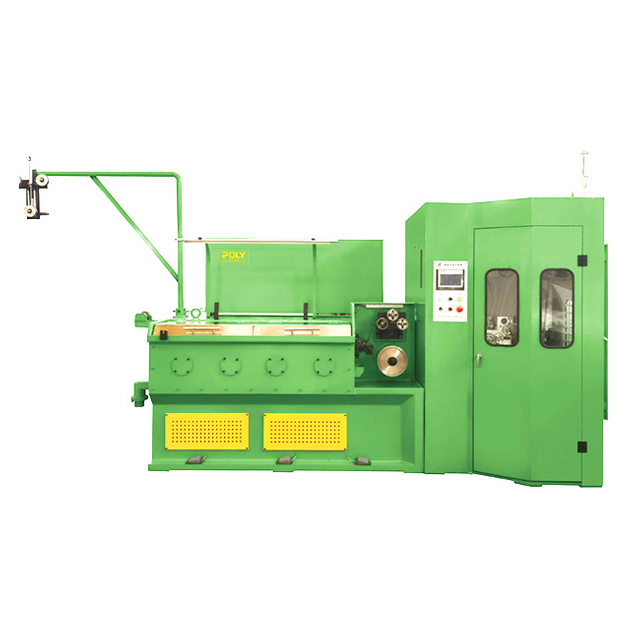
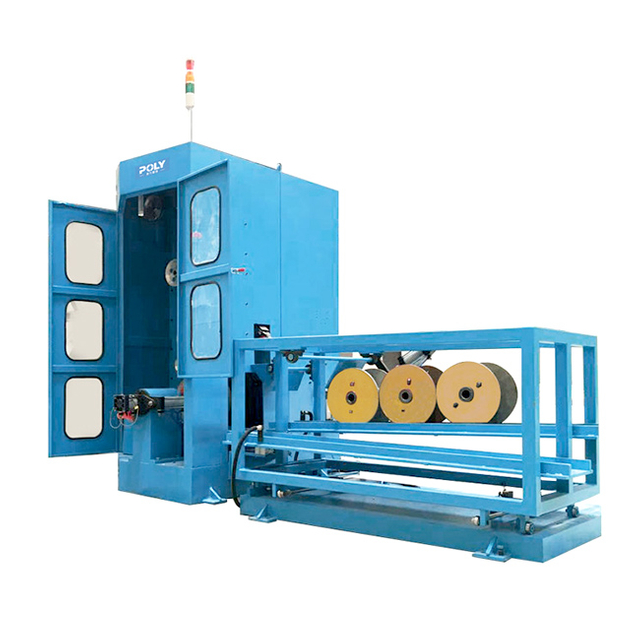
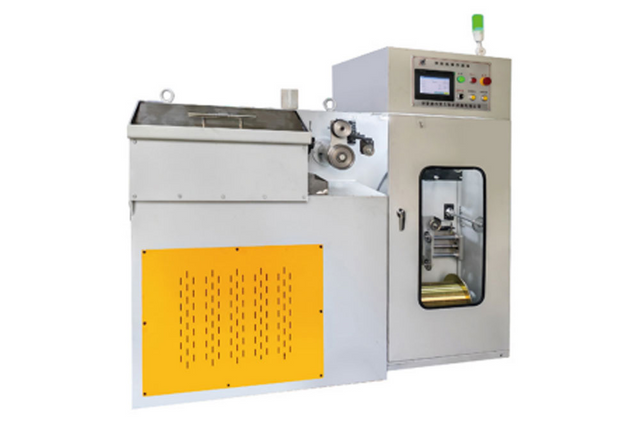
Operators must use precision alignment jigs when setting up the die bank. Visual inspection is insufficient for ultra-fine wire. You need dial indicators to verify the concentricity of the die holder relative to the wire path. A high-quality cold-drawn tungsten wire drawing machine features machined die blocks with strict tolerance controls to prevent operator-induced misalignment.
High-speed drawing of high-tensile materials generates significant kinetic energy. This energy often translates into harmonic vibrations. The machine frame must possess massive structural rigidity to counteract this. Cast iron bases or heavily reinforced steel frames are typical requirements. A lightweight frame will flex under the drawing load.
Structural rigidity ensures smooth equipment operation. It prevents harmonic vibrations from transferring to the wire path. When vibrations reach the wire, they create micro-fluctuations in tension. In ultra-fine tungsten, these fluctuations cause fatigue and instantaneous breakage. Superior vibration dampening isolates the drum wheels and die holders from external mechanical noise. This isolation is critical for maintaining micron-level diameter consistency.
You should evaluate the mounting systems of the machine. Heavy-duty leveling pads with elastomeric cores help isolate the machine from shop floor vibrations. Additionally, the drive motors should sit on independent dampening mounts. This prevents motor resonance from traveling through the chassis and into the delicate wire path.
Your machine must handle different die inserts seamlessly. Cemented Tungsten Carbide dies work well for intermediate drawing stages. They offer excellent toughness and handle moderate heat well. However, they lack the extreme hardness required for ultra-fine final passes. For these fine stages, Polycrystalline Diamond (PCD) dies become necessary. PCD provides exceptional wear resistance and maintains tight tolerances over long runs.
Nano-coated and CVD (Chemical Vapor Deposition) dies offer alternative solutions. They bridge the gap between carbide toughness and diamond hardness. Choosing the wrong wire drawing die compromises the entire operation. It ruins the surface finish immediately. It drastically increases friction within the reduction zone. Ultimately, the wrong die drags down the overall operating target diameter, resulting in rejected material.
Modern machines require integrated cooling and lubrication. The machine's delivery systems must adapt based on the chosen die material. PCD dies have high thermal conductivity. They transfer heat away from the wire quickly. The machine must supply adequate coolant to the die casing to remove this transferred heat. Carbide dies retain more heat, requiring different coolant flow rates and pressures.
The geometry of the die itself must match the machine's pulling capabilities. The approach angle, reduction zone, bearing length, and exit cone all influence the drawing force. A steep approach angle requires more pulling force but reduces contact friction. A shallow angle lowers the pulling force but increases the surface area in contact with the die, generating more heat. You must balance these geometric factors with the machine's tension control limits.
Die Material | Optimal Production Stage | Wear Resistance | Thermal Conductivity | Friction Management Needs |
|---|---|---|---|---|
Cemented Tungsten Carbide | Intermediate Reduction | Moderate | Low | High volume boundary lubrication |
Polycrystalline Diamond (PCD) | Ultra-Fine Final Sizing | Extremely High | High | Precision localized cooling |
CVD Coated | Transitional Stages | High | Moderate | Balanced cooling and lubrication |
Natural Diamond (ND) | Sub-Micron Finishing | Superior | Very High | Ultra-filtered light oil lubrication |
Cold drawing lacks external heating elements. Therefore, all deformation energy converts directly into friction-induced heat. This heat concentrates entirely within the microscopic reduction zone of the die. If left unmanaged, this heat will destroy the wire's metallurgical structure. It will also cause the die to fail prematurely.
You must implement localized cooling systems. These systems direct high-pressure coolant exactly at the die entrance and exit. Specialized boundary lubrication is equally critical. The lubricant must form a microscopic protective film between the tungsten wire and the die surface. This film prevents metal-to-metal contact. It reduces the friction coefficient and allows the wire to slide smoothly through the reduction zone.
The choice of lubricant depends heavily on the wire diameter and drawing speed. For intermediate cold passes, heavy drawing soaps or graphite-based suspensions provide robust boundary layers. However, as you move to ultra-fine diameters, these heavy lubricants can clog the die entrance. For final sizing passes, you must switch to low-viscosity synthetic oils. These oils penetrate the microscopic gap between the wire and the die, providing essential lubrication without causing blockages.
Temperature control of the lubricant itself is another critical factor. As the lubricant absorbs heat from the dies, its viscosity drops. If the oil becomes too thin, the boundary layer collapses, leading to immediate metal-to-metal contact. You must install heat exchangers within the lubrication reservoir to maintain a constant fluid temperature. Chiller units integrated into the machine's base provide the most stable temperature control, ensuring the lubricant retains its optimal viscosity regardless of the ambient shop floor conditions.
Filtration systems are mandatory for cold drawing lubricants. As the wire passes through the dies, microscopic tungsten particles shear off. If these particles remain in the lubricant, they act as an abrasive slurry. This slurry will destroy the surface finish of the wire and rapidly erode the PCD dies. You must equip your machine with multi-stage filtration units capable of removing particulate matter down to the sub-micron level.
A standalone machine cannot guarantee production success. You must assess how the equipment integrates with your entire manufacturing line. Upstream processes prepare the tungsten for cold drawing. Annealing stations relieve internal stresses generated during prior hot drawing stages. Cleaning stations remove surface oxides and residual graphite lubricants. The cold drawing machine must accept wire directly from these stations without introducing new tension variables.
Downstream integration is just as critical. Spooling and winding equipment must match the drawing speed perfectly. If the spooler pulls too hard, it stretches the finished wire. If it pulls too loosely, the wire tangles. An advanced tungsten wire drawing machine uses closed-loop communication. It syncs its final capstan speed directly with the downstream winding motors.
Payoff systems also require careful attention. The wire entering the cold drawing machine must unspool smoothly. Any snag or hesitation at the payoff stand will send a tension shockwave through the entire machine. Motorized payoff stands with dedicated dancer arms absorb these shockwaves, ensuring a steady feed rate into the first drawing die.
The payoff spool itself must be perfectly balanced. An unbalanced spool will wobble as it rotates, creating a rhythmic tension variation that travels straight into the first drawing die. Operators must use dynamic balancing machines to check every spool before loading it onto the payoff stand. Furthermore, the payoff motor must feature regenerative braking. This allows the motor to maintain back-tension on the wire even when the main drawing capstan decelerates, preventing the wire from going slack and tangling.
Realistic maintenance schedules dictate your actual production capacity. Drum wheels and capstans suffer constant abrasion from the tungsten wire. You must resurface these components frequently to maintain a smooth wire path. Wire guide wheels require daily inspection. A grooved guide wheel will scratch the wire before it even enters the die. You must also calibrate tension sensors regularly to ensure accurate load readings.
Calibrating the dancer arms requires static and dynamic testing. For static calibration, operators hang certified weights from the dancer arm and verify that the load cell output matches the physical weight exactly. Dynamic calibration involves running a test spool of wire and using a high-speed data logger to record the tension fluctuations. If the data logger shows tension spikes that the machine's HMI does not register, the load cell response time is too slow. You must replace sluggish load cells immediately, as they will fail to compensate for the micro-stutters that cause wire breakage.
Die hole wear presents a complex challenge. As the diamond die wears, the wire diameter increases. Resizing diamond dies takes significant time and specialized equipment. You can mitigate these downtime risks using quick-change die cassettes. These cassettes allow operators to swap worn dies in seconds. Automated predictive maintenance sensors also help. They monitor vibration and motor loads to predict die failure before it causes wire breakage.
To systematically address wire breakage, operators should follow a strict troubleshooting hierarchy:
Verify the incoming wire diameter to ensure the draft reduction does not exceed the 15% maximum threshold.
Inspect the die entrance for lubricant starvation or particulate clogging.
Check the capstan surface for micro-grooves that could cause tension stutters.
Recalibrate the dancer arm load cells to confirm the tension feedback loop is operating correctly.
Examine the broken wire ends under a microscope to identify cleavage fractures versus tensile necking.
Threading ultra-fine tungsten wire involves a steep learning curve. Operators must guide microscopic wire through multiple dies and capstans without snapping it. Manual threading requires immense patience and steady hands. High turnover in operator roles can severely impact your production yield.
Automation bridges this skill gap. Automated threading assists guide the wire safely through the machine path. This reduces human error and speeds up changeovers. HMI (Human-Machine Interface) diagnostic tools simplify troubleshooting. A well-designed HMI displays real-time tension graphs, motor loads, and fault locations. It empowers less experienced operators to identify and resolve issues quickly.
Training programs must focus on the physical handling of the wire. Operators must learn how to point the wire for threading without causing micro-fractures. Chemical pointing or electrolytic etching are the preferred methods for ultra-fine tungsten. Mechanical pointing methods, such as swaging or rolling, often induce stress cracks that lead to breakage during the first drawing pass.
Reducing scrap is the primary objective in fine tungsten wire production. Every meter of broken wire represents lost material and wasted processing time. You must focus on optimizing the drawing parameters to maximize material utilization. This involves fine-tuning the draft schedule, ensuring perfect die alignment, and maintaining consistent lubrication.
A high-precision machine directly contributes to scrap reduction. By minimizing tension fluctuations and preventing harmonic vibrations, the machine allows you to draw longer continuous lengths of wire. This reduces the number of short spools and offcuts generated during production. Consistent diameter control also ensures that a higher percentage of the finished wire meets the strict specifications required by end-users.
The lifespan of your drawing dies and capstans directly impacts your overall production efficiency. A machine with superior alignment and smooth guide wheel operation significantly extends the life of these consumables. When the wire enters the die perfectly straight, the wear is distributed evenly across the bearing zone. This prevents premature die failure and maintains dimensional accuracy over longer runs.
Proper lubrication and cooling are also essential for extending consumable lifespan. By managing the friction-induced heat effectively, you prevent thermal degradation of the PCD dies and reduce the abrasive wear on the capstans. Implementing a rigorous maintenance schedule for your filtration systems ensures that the lubricant remains clean and effective, further protecting your valuable tooling.
To ensure high-yield production of fine tungsten wire, implement the following actions immediately:
Audit your current die holders using dial indicators to verify absolute concentricity and eliminate micro-misalignments.
Upgrade your filtration systems to sub-micron levels to prevent tungsten particulate buildup in your drawing lubricants.
Install motorized payoff stands with dedicated dancer arms to absorb tension shockwaves before they enter the primary drawing zone.
Implement a strict capstan inspection schedule, replacing or resurfacing drum wheels at the first sign of surface grooving.
A: Modern equipment can draw tungsten wire down to 10 microns or less. Achieving these ultra-fine diameters requires exceptional tension control. It also demands flawless die alignment and premium polycrystalline diamond (PCD) dies. The exact limit depends on the specific tungsten alloy and the machine's vibration dampening capabilities.
A: The transition typically occurs when the wire diameter reaches approximately 0.1mm to 0.15mm. Below this threshold, hot drawing struggles to maintain tight dimensional tolerances. Switching to a cold-drawn system ensures superior surface finish and exact mechanical properties for the final ultra-fine sizing.
A: Accurate alignment ensures the wire enters the die perfectly straight. Misalignment forces the wire to bend, creating asymmetric stress and uneven die wear. This increases friction and causes micro-scratches. In high-tensile tungsten, these microscopic defects act as stress concentrators that lead to immediate wire breakage.
A: Polycrystalline Diamond (PCD) is the best choice for ultra-fine cold drawing. It offers extreme hardness and exceptional wear resistance. This allows it to maintain exact micron-level tolerances over long production runs. Tungsten carbide is better suited for earlier, thicker intermediate stages.
A: The wrong die material will wear out rapidly under the intense friction of cold drawing tungsten. As the die hole expands, the wire diameter increases beyond acceptable tolerances. This forces you to halt production frequently to replace dies, destroying yield and missing target specifications.
A: Because cold drawing lacks external heat, all deformation energy becomes friction-induced heat. Modern technology manages this using localized, high-pressure cooling systems directed at the die casing. It also utilizes advanced boundary lubrication to reduce the friction coefficient between the wire and the die surface.
A: Surface defects usually stem from poor die alignment, worn wire guide wheels, or inadequate lubrication. A grooved capstan or misaligned mold base will scratch the wire. Insufficient boundary lubrication allows metal-to-metal contact inside the die, causing galling and severe surface scoring on the finished wire.



 English
 简体中文
简体中文
