
- Home
- Products
- Company
- Solutions
- Advantages
- Blog
- Contact
- Hot
Views: 0 Author: Site Editor Publish Time: 2026-10-30 Origin: Site


Particulate accumulation in aluminum wire drawing is a harsh operational reality. Suspended metal fines directly degrade surface finishes. They also accelerate die wear at an alarming rate. Effective fluid management requires much more than simply circulating coolant. Rigorous aluminum wire drawing filtration acts as a critical process control variable. It dictates final product quality. It protects machine uptime and significantly reduces consumable spend. You must actively manage this fluid ecosystem to stay competitive. Drawing operations cannot afford unchecked contamination. This guide examines how you evaluate and select the right filtration architecture. We will explore how production volume dictates equipment choices. We also look at complex emulsion chemistry constraints. Finally, we cover mechanical methods to achieve specific surface finish targets consistently. Manufacturers treating filtration as an afterthought inevitably struggle to maintain long-term profitability.
Aluminum fines are non-magnetic and highly abrasive, requiring specific mechanical separation methods rather than standard magnetic filtration.
Proper aluminum wire drawing emulsion maintenance extends fluid life by up to 300% and significantly reduces disposal and chemical replenishment costs.
Selecting between centrifugal and barrier (paper/media) filtration depends heavily on your acceptable micron threshold, flow rates, and tolerance for consumable expenses.
Filtration upgrades must be balanced against the risk of stripping active lubricity additives from the emulsion.
Suspended aluminum fines pose severe threats to production lines. These tiny particles cause microscopic scoring on the wire surface. This mechanical damage rapidly increases roughness average (Ra) values. High Ra metrics directly cause batch rejections. Quality control teams cannot accept scratched wire. You lose profit every time a spool fails inspection. Clean fluid remains the only reliable defense against micro-scoring. It ensures the wire maintains a bright, consistent finish from start to finish.
Abrasive particles destroy expensive tooling quickly. Particulate-laden fluids act exactly like liquid sandpaper. They continuously grind against drawing dies and machine capstans. Hard oxides form on the aluminum fines. These oxides easily scratch tungsten carbide and diamond dies. You face frequent tooling replacements. Production lines suffer from continuous unplanned downtime. Every minute spent changing a ruined die destroys your daily yield targets.
Fluid chemistry breaks down rapidly under heavy contamination. You cannot maintain a stable drawing environment when sludge accumulates. Consider these specific chemical degradation factors:
Accumulated fines provide massive surface area for bacterial colonization.
Anaerobic bacteria excrete acids that aggressively lower fluid pH.
Tramp oils bind readily to floating aluminum dust.
This combination creates a sticky sludge inside the reservoir.
Sludge directly depletes active lubricating agents and emulsifiers.
Contaminated fluids demand frequent and expensive disposal. Environmental compliance introduces heavy financial burdens on your facility. Hauling away exhausted coolant drains maintenance budgets. Regulatory bodies classify metallic sludge as hazardous industrial waste. Rigorous aluminum wire drawing emulsion maintenance prevents these cascading chemical failures. You keep fluids cleaner for much longer periods. Extended fluid lifespans directly reduce your annual hauling expenses.
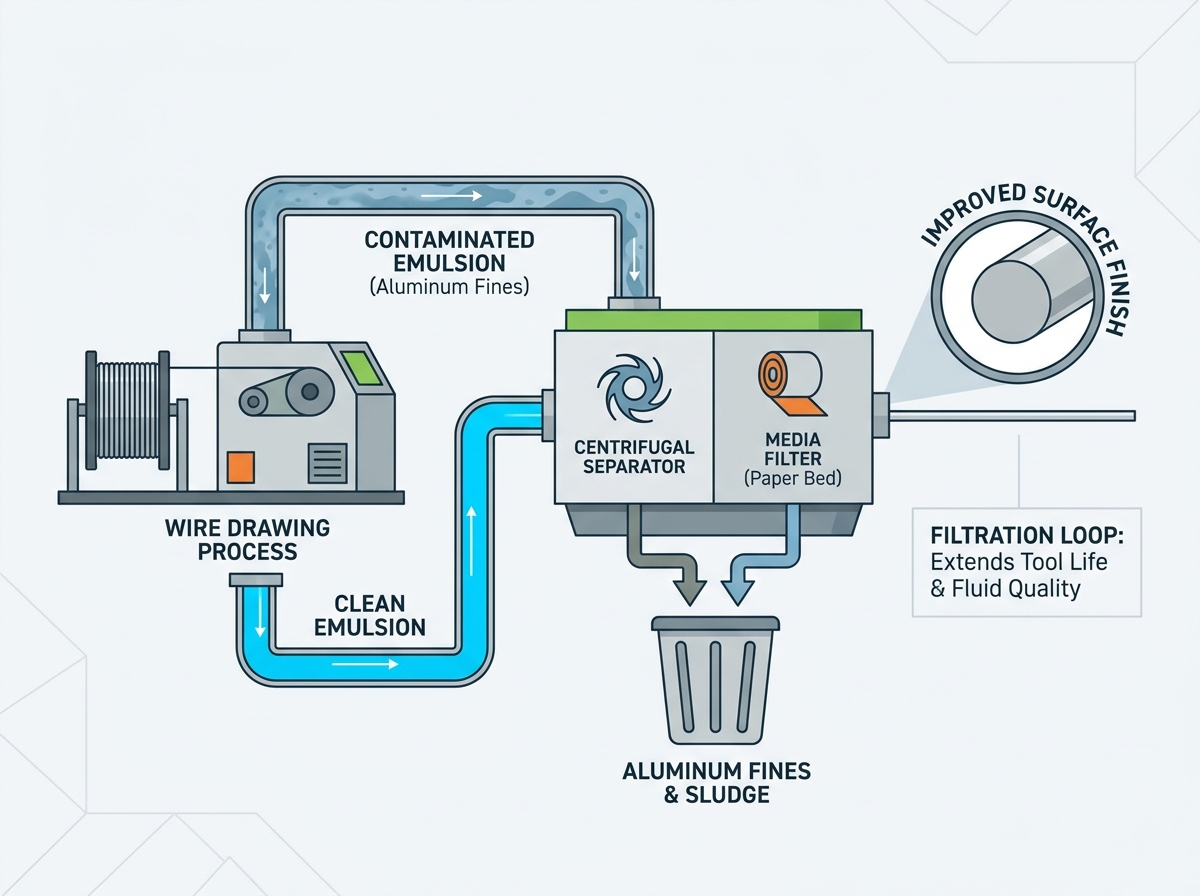
Selecting the correct mechanical approach determines your overall success. Operations must match their primary technology to their specific contamination load.
Centrifuges rely on immense physical forces. They spin contaminated fluid at extremely high RPMs. Centrifugal force pushes heavy aluminum fines outward against the bowl wall. Clean emulsion exits through the center axis. They require absolutely no consumable media. You should use them for high-volume continuous production. They handle heavy sludge loads effortlessly. Operations looking to minimize recurring supply costs strongly prefer this separation method.
Paper bed filters use physical barriers to capture debris. The system pulls or drops fluid through specialized disposable media. You achieve incredibly precise micron control. Manufacturers needing ultra-fine surface finishes rely heavily on paper beds. They suit smaller to mid-sized fluid reservoirs perfectly. Reliable wire drawing lubricant filtration often blends both centrifugal and barrier approaches for optimal results.
Skimmers offer critical ancillary support to your main systems. Hydraulic oils inevitably leak into drawing fluids during normal operation. Skimmers actively remove these floating contaminants from the sump surface. Removing tramp oil prevents anaerobic bacteria from sealing the fluid surface. It maintains vital emulsion stability. You must use oil separators in tandem alongside your primary particulate filters.
Technology Type | Primary Separation Mechanism | Ideal Production Application |
|---|---|---|
Centrifugal Separator | High-speed rotational G-force | High-volume runs, heavy sludge, zero consumable budget |
Paper Bed Filter | Physical disposable micron barrier | Precision finishes, strict micron thresholds, smaller tanks |
Tramp Oil Skimmer | Surface tension / gravity removal | Ancillary support, leak-prone older machinery |
Evaluating a new setup requires careful engineering math. You must balance micron rating constraints against absolute flow rate requirements. Engineers must calculate the necessary reservoir turnover rate. A standard industry benchmark involves filtering the entire tank volume three to five times per hour. You cannot simply install the tightest filter available. Pushing fluids through ultra-fine media under 10 microns restricts flow significantly. Reduced flow causes fluid starvation directly at the dies. Dry dies shatter instantly and ruin the wire.
System scalability and footprint demand equal attention during planning. Floor space remains a premium commodity in modern manufacturing plants. Central filtration systems process fluids for multiple drawing machines simultaneously. They require massive floor trenches and huge centralized tank farms. Conversely, localized units service individual drawing machines independently. Dedicated units fit easily into tight spaces right next to the machine. You must evaluate your future expansion plans before pouring concrete for central trenches.
Emulsion compatibility dictates final equipment selection. Your chosen filtration method must protect fluid chemistry at all costs. Harsh mechanical pumps shear delicate fat and soap additives. Aggressive barrier filtration often strips necessary boundary lubricants from the emulsion. Stripped fluids cannot protect the wire during high-speed drawing. You must verify chemical compatibility with your fluid provider before installation.
New equipment installations rarely happen flawlessly. Integration into existing sumps presents major engineering challenges. Retrofitting modern systems into legacy trenching causes complex fluid dynamic issues. Shallow tanks create low-velocity dead zones. Sludge settles heavily in these stagnant areas instead of reaching the filter. You must design proper fluid agitation jets to keep particles suspended until they reach the intake valves.
Filtration loops introduce severe foaming risks if designed improperly. Excessive mechanical agitation whips air directly into the emulsion. Improper return-flow designs splash fluid aggressively into the main tank. This violent splashing generates thick, persistent foam. Foam causes pump cavitation and dangerous fluid overflows onto the factory floor. You must submerge all return pipes well below the fluid level to prevent aeration.
Maintenance diligence determines long-term filtration success. Operators must follow strict standard operating procedures (SOPs) daily. Centrifuge bowls require regular manual cleaning to prevent imbalances. Media rolls need timely replacement before they snap. If filters blind over completely, fluid levels rise rapidly. Many systems feature automatic bypass valves to prevent flooding. If operators fail to intervene, the machine draws wire using completely unfiltered, destructive fluid.
Disposal compliance requires strict adherence to local environmental regulations. Facilities must follow proper handling protocols for compacted aluminum sludge. You cannot simply throw saturated metal fines into standard trash dumpsters. The residual oils make the sludge a regulated environmental hazard. Establish clear vendor partnerships for safe, compliant removal of all hazardous drawing byproducts.
Procurement requires systematic validation. Baseline fluid analysis serves as your mandatory first step. You must evaluate your current emulsion state deeply before spending money. Analyze the existing particle size distribution in your sumps. Measure fluid pH accurately. Calculate the exact tramp oil percentage causing issues. You need these exact performance metrics before requesting vendor quotes or proposing capital upgrades.
Prioritize manufacturers offering robust pilot testing programs. Vendors should happily provide on-site trial units for evaluation. Test the equipment on your actual production lines under real loads. Request detailed case studies from the supplier. Demand empirical data showing actual Ra finish improvements in identical aluminum applications. Never purchase a complex system based on brochure promises alone.
Define rigid success metrics prior to issuing any purchase orders. Establish clear Key Performance Indicators (KPIs) for your maintenance teams. You might target a 40% reduction in die consumption. Perhaps you want to extend fluid dump intervals from three months to twelve months. Document these specific goals. Hold vendors accountable to these exact performance benchmarks during the commissioning phase.
Effective fluid management represents a direct investment in product quality. It preserves expensive tooling longevity. It acts as far more than a simple waste management chore. Upgrading your systems guarantees better wire finishes and fewer production stops. Start your procurement process today by mapping your current contamination baseline. Conduct a comprehensive fluid analysis of your existing sumps. Identify your exact particulate loads to make informed decisions.
Follow these immediate next steps to improve your operations:
Pull fluid samples from active drawing zones for lab analysis.
Document your current weekly die replacement rates.
Calculate total fluid disposal volumes over the past year.
Consult with your chemical supplier regarding additive stability.
Request pilot trial units from top filtration manufacturers.
A: The standard target ranges between 10 and 20 microns. Going below 10 microns risks stripping vital fat and soap additives from the emulsion. These additives provide necessary hydrodynamic lubrication. Conversely, allowing particles larger than 20 microns to circulate introduces severe abrasive damage. You must balance fluid cleanliness against chemical stability.
A: No. Aluminum is inherently non-magnetic. Standard magnetic separators cannot pull aluminum fines out of the fluid stream. You must rely entirely on mechanical separation methods. High-speed centrifuges or physical barrier filters remain the only effective ways to remove these abrasive non-ferrous particles from your coolant.
A: Change frequencies depend heavily on your production volume and equipment type. Continuous auto-indexing paper beds handle changes automatically as fluid levels rise. Operators only replace the bulk paper roll weekly or monthly. Manual centrifuge cleanouts require intervention much more frequently. Heavy sludge loads often demand daily manual bowl scraping.



 English
 简体中文


