
- Home
- Products
- Company
- Solutions
- Advantages
- Blog
- Contact
- Hot
Views: 0 Author: Site Editor Publish Time: 2026-10-25 Origin: Site


Processing stainless steel presents extreme engineering challenges. High work-hardening rates and intense friction constantly threaten your production yields. These harsh metallurgical factors directly impact die costs, machine uptime, and final wire surface finish. In stainless steel wet wire drawing, your profit margin depends heavily on thermal management. The efficiency of your lubrication and die cooling systems dictates whether you achieve high-speed continuous production or suffer from costly operational bottlenecks. We created this comprehensive guide for engineering and procurement teams evaluating modern drawing technologies. You will learn how to specify, upgrade, and invest wisely in industrial wire drawing systems. We cover everything from evaluating fluid dynamics to selecting robust capstan metallurgy. Expect practical insights to optimize your manufacturing capabilities and safeguard your tooling investments.
Effective stainless steel wet wire drawing requires purpose-built fluid circulation to combat rapid strain hardening and prevent galling.
Evaluating a wire drawing machine for stainless steel wire must prioritize capstan cooling efficiency, submerged die configurations, and automated fluid filtration.
Transitioning to advanced wet lubrication systems reduces tooling costs (die wear) but requires strict adherence to fluid maintenance and temperature control protocols.
Total Cost of Ownership (TCO) for stainless steel wire drawing equipment is heavily influenced by energy efficiency, coolant lifecycle management, and machine uptime during high-speed continuous drawing.
Stainless steel possesses notoriously low thermal conductivity. It also features high tensile strength. When you draw this metal, heat does not dissipate quickly through the wire itself. Instead, extreme thermal energy concentrates directly at the die-wire interface. This localized heat creates severe tribological stress during high-speed production.
Thermal failure leads to cascading operational expenses. When cooling systems fail, carbide dies experience thermal cracking. The wire surface suffers from scoring and galling. Operators must then halt the machine frequently to replace damaged dies. These unplanned machine stops cripple overall equipment effectiveness and inflate your scrap rates.
A successful wet drawing operation achieves several distinct benchmarks. You should look for:
Sustained high drawing speeds without fluid boiling.
Highly predictable and uniform die wear.
Consistent wire tensile properties across the entire spool.
Zero surface blemishes or microscopic scratching on the finished product.
You generally choose between neat oils and water-soluble emulsions. Neat oils offer superior extreme-pressure (EP) boundary lubrication. This protection is absolutely critical for resisting the abrasive nature of stainless steel. Conversely, emulsions provide significantly better heat dissipation. Your choice depends entirely on whether friction reduction or thermal extraction ranks higher for your specific wire diameter.
Manufacturers typically use either bath systems or targeted spray applications. Bath or submerged drawing surrounds the entire die assembly in fluid. Submerged systems are practically mandatory for fine stainless wire. They ensure an unbroken boundary layer of protection. Spray systems work well for larger diameters but often fail to penetrate the die reduction cone efficiently.
Continuous removal of metallic fines is non-negotiable. Microscopic sludge builds up rapidly in your fluid reservoir. We strongly recommend installing robust magnetic separators and paper band filters. These systems capture particulates before they circulate back into the die box. Proper filtration prevents particulate-induced wire scratching and extends your lubricant lifespan.
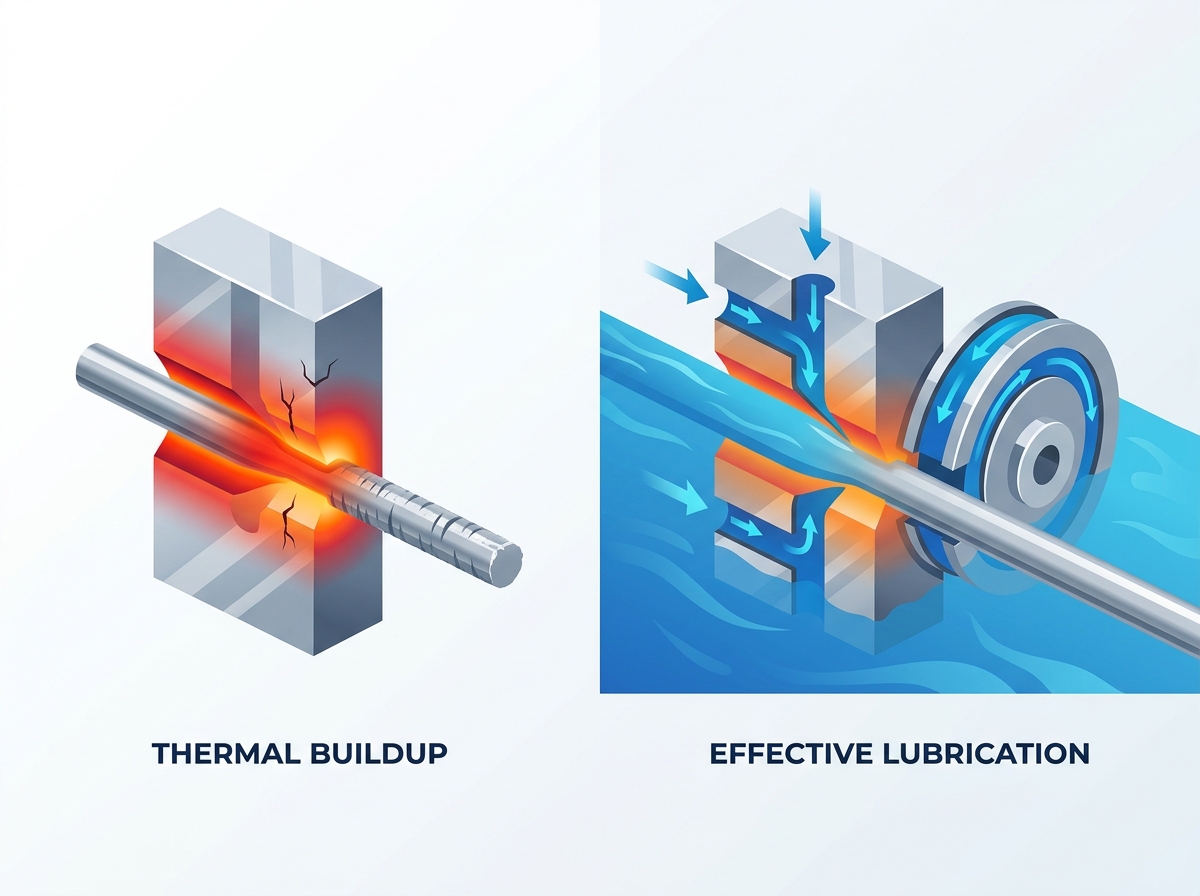
Modern wire drawing machines utilize dual-cooling strategies. Indirect cooling happens inside the equipment. Internal water channels cool the capstans continuously. Direct cooling applies pressurized fluid straight to the die inlet. You need both mechanisms working together to handle the intense heat generated by stainless steel alloys.
Cooling Type | Application Point | Primary Benefit | Key Requirement |
|---|---|---|---|
Direct Cooling | Die inlet and wire surface | Immediate friction reduction | High-pressure pump systems |
Indirect Cooling | Internal capstan walls | Bulk heat extraction | Clean, scale-free water supply |
High-speed drawing creates immense hydrodynamic resistance. Standard die holders cannot force enough lubricant into the reduction cone. You need pressurized die boxes to overcome this barrier. These specialized holders pump fluid actively into the working zone. This feature prevents boundary layer collapse during rapid acceleration.
Thermal breakdown destroys lubricating additives. You must keep coolant temperatures strictly controlled. Maintain your fluid reservoir between 40°C and 50°C. Exceeding this range causes rapid lubricant degradation. Integrated heat exchangers and industrial chillers are essential components for stabilizing these temperatures during continuous multi-shift operations.
Stainless steel acts like a grinding file against soft metals. Specifying standard steel blocks guarantees premature equipment failure. You must demand high-grade tungsten carbide capstans. Alternatively, specialized ceramic-coated capstans offer excellent abrasion resistance. These hardened surfaces resist grooving and ensure long-term dimensional stability.
You must evaluate slip versus zero-slip kinematics carefully. Fine stainless applications benefit immensely from zero-slip configurations. They prevent surface abrasion caused by wire sliding. Look for advanced AC variable frequency drives (VFDs). Pair them with precise dancer arms. This combination maintains perfect tension and completely prevents wire breakage.
Consider your overall factory footprint before purchasing. A reliable wire drawing machine for stainless steel wire must integrate smoothly. Check compatibility with upstream pay-offs and inline descaling units. Ensure downstream spoolers and take-ups can match the main line speed. Seamless integration minimizes manual handling and reduces overall scrap.
Managing wet drawing systems requires dedicated labor. Your team must monitor fluid concentrations daily. They must also check pH balances to prevent bacterial growth in emulsions. Regular system cleanouts remove compacted sludge from the reservoir. Ignoring these tasks leads directly to compromised wire finishes and damaged tooling.
Industrial drawing fluids pose specific environmental challenges. Disposing of hazardous coolants carries strict regulatory compliance rules. You must select equipment designed to minimize fluid drag-out. Efficient air wipes and containment guards reduce chemical consumption dramatically. They also lower your monthly waste disposal expenses.
Investing in advanced thermal management delivers measurable returns. Calculate your payback period by measuring three distinct variables. First, track the value of increased drawing speeds. Second, measure the reduction in die replacement frequency. Finally, account for the lower scrap rates achieved through consistent wire tensile properties. High-quality stainless steel wire drawing equipment usually pays for itself through these three efficiency gains.
Never accept vague promises from equipment OEMs. Demand written guarantees for continuous drawing speeds. Specify your exact 300 or 400 series stainless grades in the contract. Ask vendors to provide documented die life baselines. These metrics hold manufacturers accountable for their machine's actual floor performance.
Ship sample spools of your specific stainless alloy to the vendor.
Run a full-speed trial on their demonstration equipment.
Inspect the finished wire for surface finish quality.
Conduct laboratory tests to verify tensile consistency.
Machine downtime burns through your capital quickly. Evaluate the vendor's ability to dispatch spare parts immediately. Focus specifically on proprietary die holders and replacement capstan rings. Additionally, verify their remote diagnostic capabilities. Modern machines should allow factory engineers to troubleshoot PLC faults securely over the internet.
Mastering stainless steel production requires balancing aggressive pulling forces with precision tribology.
Upgrading to submerged die cooling prevents thermal cracking and dramatically extends tooling life.
Implementing continuous automated filtration eliminates microscopic scratches and guarantees a flawless wire finish.
Procurement teams should prioritize advanced VFD tension controls to completely eliminate fine wire breakage.
Always request detailed fluid handling schematics during vendor evaluations to ensure easy long-term maintenance.
A: You should maintain fluid temperatures strictly between 40°C and 50°C. Exceeding this thermal threshold degrades the lubricant's essential boundary additives. When these additives break down, friction spikes immediately, leading to wire galling and accelerated die wear.
A: Stainless steel undergoes rapid work hardening and possesses extreme abrasive qualities. Standard steel blocks will groove and wear out almost instantly. You must use specialized tungsten carbide or ceramic-coated capstans to resist this severe abrasive damage.
A: No, you should avoid sharing equipment. Different metals require entirely different slip ratios and lubricant chemistries. Mixing them causes cross-contamination. Microscopic metal fines will trigger galvanic corrosion and ruin the surface finish of both materials.
A: Without proper filtration, microscopic stainless fines accumulate in the lubricant. These hard particles act exactly like a grinding compound inside the die box. They aggressively destroy the internal die geometry and deeply scratch the finished wire surface.



 English
 简体中文


