
- Home
- Products
- Company
- Solutions
- Advantages
- Blog
- Contact
- Hot
Views: 0 Author: Site Editor Publish Time: 2026-11-09 Origin: Site


Processing high-tensile materials creates immense mechanical stress. You need massive torque, flawless tension control, and non-stop operation to succeed. Engineers face a difficult choice when configuring a large diameter wire drawing machine. The metalworking industry is rapidly shifting. We see major manufacturers constantly moving away from legacy mechanical systems. They now favor advanced electronic motor configurations. This transition fundamentally changes production reliability and factory operating expenses.
How do you properly evaluate these competing transmission architectures? You need a pragmatic, evidence-based framework. This guide explores the core engineering differences between traditional mechanical systems and modern electronic setups. You will discover exactly how tension accuracy impacts your final wire quality. We will outline the capital expenditure and energy efficiency realities of each system. By the end, you will know precisely which transmission configuration best suits your specific heavy manufacturing goals.
Gearbox transmissions offer proven high-torque delivery at lower initial costs but suffer from mechanical energy losses (typically 10-15%) and higher maintenance downtime.
Individual drive wire drawing machines (often utilizing direct drive servos) provide superior tension accuracy and energy efficiency, significantly lowering the Total Cost of Ownership (TCO) despite a higher upfront investment.
For an alloy wire drawing machine, the choice dictates not just power consumption, but final wire surface quality and die life due to micro-slip reduction.
Facility readiness—specifically regarding advanced PLC integration and cooling infrastructure—is the primary bottleneck when adopting direct drive systems.
Processing specialized heavy metals pushes standard equipment to absolute limits. Tough industrial alloys behave much differently than standard copper or mild steel. Solid titanium, high-carbon steel, and specialized aerospace alloys resist deformation aggressively. They snap easily if processed incorrectly.
You need maximum pulling torque at very low starting speeds. Drawing heavy wires requires massive physical force just to initiate the metal deformation process. If the machine cannot sustain this intense low-speed torque, the wire will yield and break. Traditional motors often struggle in this specific scenario. They usually rely on mechanical reduction to multiply their pulling force. Engineers must carefully balance rotational speed and sheer motor power. High tensile materials always demand extreme structural rigidity from the entire driving mechanism.
Tension control ultimately makes or breaks your product. When wire slips slightly around the drawing capstan, micro-slip occurs. This invisible sliding friction generates immense localized heat. It leads directly to accelerated die wear and frequent wire breakage. Poor tension control also causes severe surface scoring on delicate alloys. The transmission mechanism acts as your primary quality-control bottleneck. When comparing an individual drive vs gearbox wire drawing machine, completely eliminating this slip becomes a top priority for factory managers.
Power draw drives your major operating expenses. Heavy wire processing consumes massive amounts of electricity every hour. Every physical mechanical linkage absorbs some of this input energy. Friction inside thick gear sets turns expensive factory electricity into useless waste heat. Evaluating mechanical efficiency against precise electrical efficiency reveals many hidden operating costs. You must closely track every consumed kilowatt. Daily energy loss heavily dictates an operation's long-term profitability.
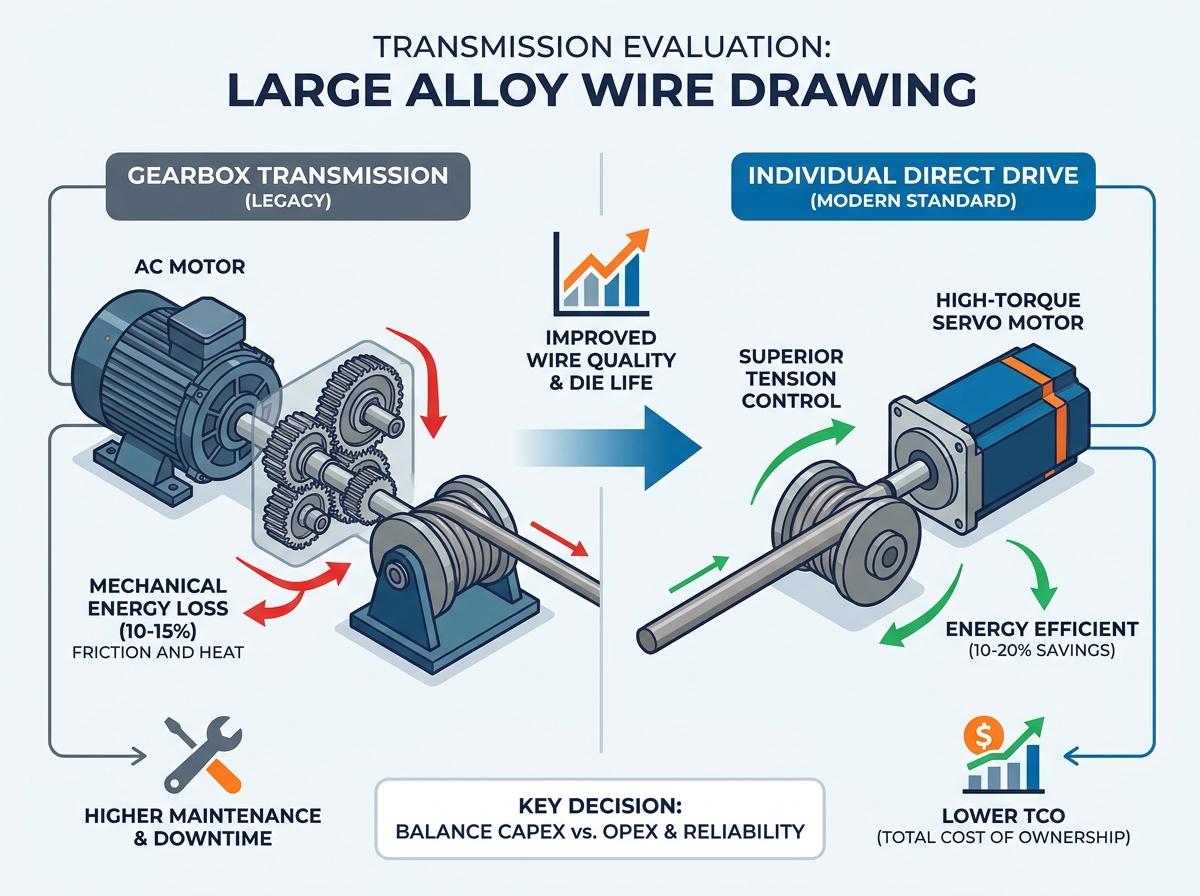
Pure mechanical advantage dominated exactly the wire manufacturing industry for decades. Massive gearboxes provided the brute force necessary for heavy metal processing before advanced electronics existed.
A traditional baseline setup uses a large central alternating current (AC) motor. Heavy mechanical gear trains connect this main motor to the drawing capstans. The intersecting gears multiply the motor torque strictly mechanically. Internal steel shafts, drive belts, and pulleys systematically distribute the motor power across all the drawing blocks in the line.
Many reliable facilities still prefer this older method today. It offers several distinct benefits for traditional factory operations.
Lower Initial Investment: You spend much less capital upfront. Standard AC motors and solid steel gears cost remarkably less than high-tech servo systems.
Familiar Maintenance: Your mechanical teams already understand physical gears. They know precisely how to grease bearings, align shafts, and swap drive belts.
Reliable Torque: Physical gears naturally multiply low-speed torque predictably. They do not require any complex electronic tuning or software updates to maintain base pulling power.
Mechanical systems inevitably degrade over long production cycles. Their physical limitations create ongoing, unavoidable production hurdles.
Mechanical Degradation: Gears suffer from inherent mechanical backlash. Steel teeth wear down after millions of heavy rotations. This wear gradually destroys your critical tension accuracy.
Parasitic Energy Loss: Internal friction robs you of usable power. Thick oil shear and kinetic heat generation usually consume up to 15% of your total input energy.
Maintenance Burden: You face constant routine upkeep. Your maintenance team must perform frequent messy oil changes and regular vibration monitoring routines. Severe catastrophic mechanical failures always pose a constant safety risk.
Common Mistake: Ignoring seemingly minor vibrations in a gearbox entirely. Small harmonic sound changes often signal closely impending tooth failure or bearing collapse.
Digital technology now effectively replaces heavy mechanical linkages with smart software and silicon components. The industry pivot is undeniable.
The individual motor wire drawing approach changes the entire machine layout. Each independent drawing block gets its own dedicated power unit. In a modern direct drive setup, the drawing capstan mounts directly to a high-torque servo motor. This physical arrangement eliminates the massive gearbox entirely. A dedicated variable frequency drive (VFD) controls each motor perfectly independently.
Upgrading your plant to a direct drive wire drawing machine fully transforms your production floor.
Energy Efficiency: You eliminate wasteful mechanical transmission losses completely. Advanced facilities frequently reduce their overall energy consumption by 10% to 20% on the very first day.
Precision Control: Complex drive controllers provide instantaneous, micro-second torque response. Flawless motor synchronization drastically reduces dangerous wire slip and sudden breakage.
Reduced Maintenance Footprint: Fewer moving parts drastically simplify your upkeep. You experience absolutely no dirty oil leaks, significantly reduced vibration, and noticeably lower ambient noise.
Embracing modern electronics naturally introduces new technical facility requirements. You must plan for them carefully.
Higher Initial Capital: Premium high-torque motors cost a premium. Sophisticated electronic drive controllers require a noticeably larger upfront capital budget.
Electrical Skill Requirements: Your team desperately needs automation troubleshooting skills. Basic mechanical knowledge alone simply cannot fix a complex software fault.
Thermal Management: Sustained heavy drawing loads generate intense internal motor heat. You must install robust water or aggressive forced-air cooling infrastructure immediately.
Best Practice: Always strictly monitor servo motor stator temperatures. Implement automated thermal shut-offs. This safely prevents expensive servo damage during aggressive, heavy drawing cycles.
Comparing these complex systems requires looking well beyond the basic spec sheet. You must evaluate precisely how each architecture physically aligns with your harsh production environment.
Raw upfront costs tell only half the actual story. A sophisticated direct drive setup undeniably demands higher initial capital. However, you must carefully evaluate your financial recovery based strictly on localized energy costs. The 10% to 20% electrical power savings compound extremely rapidly in high-volume production. Factories operating in regions with exceptionally expensive electricity recover their technological premium astonishingly quickly. You must audit your current facility power bills accurately. Compare the hidden mechanical waste heat directly against the clear acquisition cost of new servos.
Severe mechanical backlash ruins highly sensitive alloys. When worn gears shift under a heavy load, tension spikes unpredictably. This sudden shift causes microscopic surface tears on the metal. Advanced individual drives eliminate this messy gear backlash entirely. The precise digital synchronization translates directly to much tighter physical tolerances. You immediately achieve a brilliantly superior surface finish. If you happen to process high-value aerospace or delicate medical alloys, this quality improvement remains entirely non-negotiable.
Modern agile production heavily demands flexibility. Individual electronic drives allow for non-slip accumulation safely between blocks. You can easily integrate them directly into automated, complex multi-pass drawing lines. Simple software updates can suddenly adjust speed profiles instantly. Outdated gearboxes solidly lock you into stiff, fixed mechanical ratios permanently. Changing a stubborn gearbox ratio requires huge physical downtime and ordering new heavy parts.
Valuable physical floor space truly matters in modern plants. Individual electronic drives consistently create a much more compact machine footprint. They aggressively remove bulky cast-iron gear housings and incredibly long drive shafts. Operator safety improves dramatically across the board as well. You effectively eliminate dangerous rotating mechanical hazards and heavy snapping drive belts. Dedicated operators experience significantly less deafening noise pollution daily on the busy factory floor.
Transmission Architecture Comparison
Evaluation Criteria | Gearbox Transmission | Individual / Direct Drive |
|---|---|---|
Energy Efficiency | Moderate (10-15% mechanical loss) | High (Minimal transmission loss) |
Tension Control | Acceptable, but degrades with gear wear | Exceptional, software-synchronized |
Maintenance Needs | High (Thick oil, heavy lubrication, alignment) | Low (Cooling monitoring, minor electrical checks) |
Physical Footprint | Large and extremely bulky | Noticeably compact and streamlined |
Logistically adopting new transmission technology involves major facility hurdles. You must meticulously plan the entire transition very carefully.
Should you carefully upgrade or entirely replace? Retrofitting an older beloved alloy wire drawing machine seems highly cost-effective at first glance. However, safely mounting high-torque electronic servos to old rusty frames usually proves intensely difficult. Old cast-iron machine bases normally lack the strictly necessary internal cooling channels. Safely commissioning a brand new greenfield machine guarantees perfect structural compatibility. It allows you to heavily optimize the entire production line for direct drive efficiency.
Instantaneous synchronization requires absolutely massive data throughput natively. You desperately need a highly robust Programmable Logic Controller (PLC). Your central facility must support blazing high-speed bus communication protocols like EtherCAT or PROFINET. These specific active networks manage the instantaneous electronic motor synchronization beautifully. Ancient legacy control panels simply cannot process sensor data fast enough to prevent microscopic wire slip.
You automatically become highly reliant on specialized proprietary components. Proprietary torque motors can sometimes face severe global supply chain delays. Ensure your carefully chosen OEM provides written long-term availability guarantees safely. You also critically need highly consistent drive firmware updates for maximum security. Deliberately choose technology vendors with a deeply proven track record in heavy industrial automation.
Your loyal maintenance department must rapidly evolve. Deliberately transition their routine daily schedules. They must forcefully move away from messy mechanical lubrication routes safely. Properly train them instantly in advanced electrical diagnostics and smart thermal monitoring. They precisely need to understand complex VFD fault codes. Detailed software troubleshooting quickly becomes vastly more critical than turning a heavy physical wrench.
Choosing the correct transmission architecture directly dictates your heavy manufacturing future. Carefully consider the following steps.
Shortlisting Logic: Choose legacy gearbox transmissions only for highly budget-constrained internal projects. They also suit isolated facilities that completely lack automation-trained maintenance staff currently.
Final Recommendation: Processing delicate high-value alloys heavily demands precision. The sheer energy savings and notable yield improvements of individual electronic drives easily justify the initial technological premium. They structurally offer a fast return on initial capital typically within 24 to 36 solid operating months.
Next-Step Action: Audit your current expensive machine downtime immediately. Critically analyze your latest operational energy bills carefully. Readily use this financial data to confidently build a concrete business case for your next capital procurement cycle.
A: Direct drive systems perform much better for this task. Thick high-carbon wire physically requires immense starting torque. While old gearboxes handle basic torque well mechanically, they entirely lack precise tension control. Individual drives seamlessly provide instant, software-controlled torque adjustments precisely. This advanced precision firmly eliminates problematic micro-slip and securely protects the structural integrity of the high-carbon material during heavy deformation.
A: Yes, but it is rarely financially advantageous. You constantly face severe heavy engineering complexities. The aging machine frame requires very expensive custom mechanical mounting for the brand new servos. You must completely replace the tired legacy electrical panels with highly modern PLCs. Buying a purpose-built direct drive machine normally proves vastly more reliable and surprisingly economical.
A: You can comfortably expect realistic energy savings firmly between 10% and 20% total. This exact statistical range depends immensely on the current condition of your legacy gearboxes. Old damaged gearboxes constantly lose massive engine power simply to thick friction and intense oil shear. Direct drives aggressively eliminate this physical waste entirely, cleanly transferring pure electrical power directly to the drawing capstan.
A: Yes, incredibly significantly. Random wire breakage often dangerously stems from sudden, violent tension spikes. Advanced individual drives natively use instantaneous electronic torque control perfectly to maintain perfectly steady tension. This brilliant synchronization seamlessly reduces nasty micro-slip securely across the heavy capstans. Lowering the completely unpredictable tensile stress on the wire directly prevents most unexpected snapping during fast production.



 English
 简体中文


