
- Home
- Products
- Company
- Solutions
- Advantages
- Blog
- Contact
- Hot
Views: 0 Author: Site Editor Publish Time: 2026-10-08 Origin: Site


Scaling up to heavy-gauge wire dimensions presents a profound engineering hurdle. Standard processing logic simply fails at this scale. You face exponential increases in friction, mechanical resistance, and trapped core heat. Handling these massive material volumes requires flawless execution. These realities define the complex arena of large diameter alloy wire drawing. In heavy-duty applications like aerospace fasteners or industrial cables, poor drawing parameters carry steep consequences. They accelerate die wear, trigger catastrophic breaks like wire cupping, and ruin internal grain structures. Plant managers cannot rely on guesswork to process these materials. You need specific equipment engineered for immense torque and aggressive heat extraction. This article provides a clear, evidence-based framework for evaluating machinery specifications. We will focus deeply on optimizing pass planning strategies and configuring robust thermal management architectures.
Precision in Pass Planning: Cumulative reduction-in-area (RIA) must be meticulously calculated for large diameters to balance yield strength gains against the risk of work hardening.
Thermal Management is Non-Negotiable: Heavy-gauge alloys generate extreme friction; evaluating direct vs. indirect cooling efficiency is critical to preventing surface degradation.
Torque Over Speed: A specialized large diameter wire drawing machine prioritizes continuous, high-torque block performance over pure processing speed.
Standard wire drawing logic does not scale linearly. You cannot simply apply fine-wire principles to massive cross-sections. Large-diameter materials retain core heat significantly longer. They possess a much lower surface-area-to-volume ratio. This physical trait demands exponentially more drawing force to deform the metal. Standard machines buckle under this intense mechanical stress. They lack the structural rigidity required for continuous heavy-gauge production.
Material variables introduce further complexity into the operation. Specific alloys respond uniquely to severe plastic deformation. High-carbon steel requires strict temperature limits to avoid undesirable martensitic transformation. Titanium demands exceptional lubrication to prevent surface galling. Nickel-chromium alloys exhibit rapid strain hardening during early passes. You must adapt your machine settings to these distinct metallurgical behaviors. Using a one-size-fits-all approach guarantees material failure.
We must define clear success criteria for heavy-gauge implementation. A successful operation achieves consistent dimensional tolerances across the entire spool. It preserves the internal grain structure without inducing micro-fractures. It minimizes die replacement frequency through optimized lubrication and cooling. Finally, it delivers predictable production yields. Meeting these benchmarks requires carefully balancing mechanical force, processing speed, and thermal extraction.
Calculating draft schedules for heavy gauges requires precise engineering logic. You must evaluate reduction ratios meticulously. Aggressive single-pass reductions create dangerous internal stresses. They often cause internal fracturing or central bursting, commonly known as cupping. Conversely, overly conservative passes waste energy and valuable floor space. They require too many drawing blocks to achieve the final diameter. Finding the optimal reduction-in-area (RIA) percentage per pass is critical.
Pass planning directly dictates the material hardening curve. Every reduction pass increases the yield strength. It simultaneously decreases ductility. An advanced large diameter wire drawing machine offers programmable draft flexibility. This feature accommodates different alloy grades seamlessly. Operators can adjust the reduction sequence to match the specific strain-hardening exponent of the metal. This control prevents the wire from becoming too brittle before reaching the final die.
Die sequence and internal geometry play massive roles in draft success. Approach angles and bearing lengths must shift as the wire diameter decreases across the block sequence. Initial heavy breakdown passes require broader approach angles. These angles help channel thick lubricant layers into the deformation zone. Later passes require tighter angles to ensure dimensional precision. We highly recommend mapping these geometric shifts before beginning any production run.
Parameter | Initial Breakdown Passes | Intermediate Passes | Finishing Passes |
|---|---|---|---|
Approach Angle | 14° - 16° | 12° - 14° | 10° - 12° |
Bearing Length | 30% - 40% of Diameter | 40% - 50% of Diameter | 50% - 60% of Diameter |
Reduction Area (RIA) | 20% - 25% | 15% - 20% | 10% - 15% |
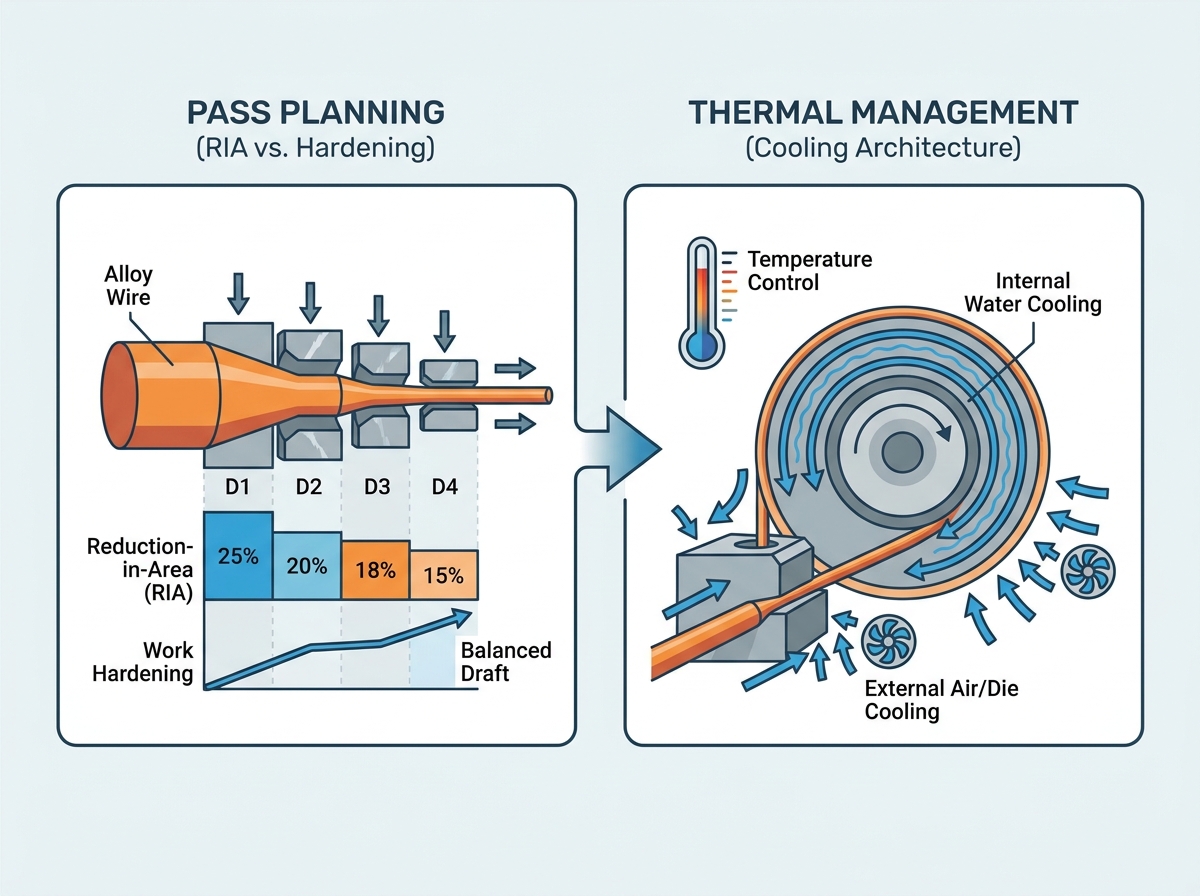
The heat dissipation challenge dominates heavy-gauge wire production. Thick wire mass generates enormous friction during deformation. This friction traps extreme heat deep at the core. Unmanaged heat alters the internal metallurgical properties. In certain high-carbon steels, it risks unwanted martensitic transformation. This makes the wire dangerously brittle. In other sensitive alloys, trapped heat causes surface burning and degrades the finish quality.
Capstan cooling systems dictate the survival of your production run. You must prioritize internal block cooling methods. Narrow-gap internal water cooling is an absolute necessity. It forces high-velocity water closely against the internal block wall. This design maximizes thermal transfer away from the drawing surface. A standard wide-gap cooling jacket cannot remove heat fast enough for heavy gauges.
External systems support the primary block cooling. Forced air cooling and direct die cooling play vital roles. The machine must maintain optimal temperatures for drawing lubricants. Dry soap powders or wet emulsions break down under immense pressure if temperatures spike. Lubricant film breakdown leads directly to catastrophic die failure. Proper external cooling prevents this thermal breakdown.
High-Velocity Internal Jackets: Utilize narrow-gap designs to maximize turbulent water flow and heat extraction.
Direct Die Flooding: Employ dedicated liquid lines pointing directly into the die entry zone.
Air Blast Systems: Position high-flow external fans to cool the wire as it travels between blocks.
Temperature Interlocks: Integrate sensors to halt the machine if die temperatures exceed critical thresholds.
Real-time temperature monitoring ensures quality assurance and compliance. Highly regulated industries demand strict traceability. Aerospace and automotive sectors follow rigid ASTM standards. They require proof that wire processing stayed within defined thermal boundaries. Integrating pyrometers and thermal sensors directly into the drawing sequence provides this crucial data. It prevents non-compliant material from ever reaching the end-user.
Evaluating an industrial alloy wire drawing machine begins with drive and torque specifications. You must look past pure processing speed. Heavy-gauge applications demand low-speed, high-torque capabilities. Robust AC variable frequency drives provide the necessary control. Specialized gearboxes translate motor power into immense pulling force. These heavy-duty components act as the primary indicators of a capable machine.
Capstan durability represents another non-negotiable evaluation criterion. Large-diameter alloys cause severe abrasion. Standard block surfaces degrade rapidly under this friction. You need extreme surface treatments to withstand the load. Tungsten carbide coating provides the necessary hardness. It extends the capstan lifespan and maintains a pristine wire surface finish throughout prolonged production cycles.
Wire handling and threading pose significant logistical difficulties. Manipulating thick alloy wire manually is dangerous and exhausting. You must evaluate automated handling features. Heavy-duty pointing machines taper the thick wire ends easily. Motorized threading pullers drag the stubborn material through the die box safely. Reverse-jog capabilities allow operators to precisely adjust tension. These features transform a grueling setup process into a manageable routine.
Safety guarding and enclosure designs protect your operators. Heavy-gauge wire stores massive kinetic energy under high tension. If a wire snaps, it whips violently across the plant floor. Robust safety enclosures contain these dangerous events. Fail-safe braking systems are mandatory evaluation criteria. They must stop massive rotating blocks instantly upon a wire break. Never compromise on these mechanical safeguards.
Physical facility infrastructure dictates deployment success. Heavy machinery requires specialized structural support. You must address the physical footprint carefully. Heavy-gauge drawing generates intense vibrations. Foundation depth and reinforced concrete specifications matter immensely. Furthermore, industrial water cooling capacity must match the machine's thermal output. Insufficient facility plumbing will handicap your operation from day one.
Operator adoption introduces major transition risks. Moving from standard wire to heavy-gauge drawing demands specialized training. The physical mechanics change entirely. Operators must learn how to handle multi-ton spools safely. They need extensive training on managing high tension limits. Threading thick wire improperly leads to severe injuries. You must invest deeply in safety protocols and operational workshops before full production begins.
Verify foundation reinforcement requirements before delivery.
Upgrade ambient ventilation systems to manage increased heat output.
Conduct dedicated crane and hoist training for handling massive spools.
Establish strict lock-out/tag-out procedures tailored to high-torque gearboxes.
We strongly recommend rigorous pilot testing protocols. Insist on a proof-of-concept run using your exact alloy chemistry. Do not accept tests on generic mild steel. This pilot run validates your calculated pass plans. It allows engineers to measure actual power consumption accurately. You can inspect final wire properties, such as tensile strength and straightness, before providing the final sign-off. This step eliminates post-installation surprises.
Success in processing heavy-gauge alloys relies entirely on technical preparation. You must meticulously calculate pass planning to manage yield strength and prevent work hardening. Thermal control dictates the physical integrity of the final product. Massive material volumes trap heat, requiring aggressive internal and external cooling architectures. Without these, you risk ruined internal grain structures and frequent tool failure.
Repurposing standard equipment for these tasks leads directly to operational breakdown. You need purpose-built machinery engineered specifically for high torque and thermal extraction. Focus your evaluations on heavy-duty gearboxes, tungsten carbide capstans, and automated threading assistance. These specific features separate capable industrial lines from inadequate alternatives.
Your next step requires immediate internal assessment. Audit your current yield strength limitations and dimensional tolerance capabilities. Consult with specialized equipment engineers to simulate a customized draft schedule. Running these simulations now will guide you toward the exact machinery specifications needed to scale your heavy-gauge production safely.
A: It varies by alloy, but typically ranges between 15% to 25% per pass. High-tensile alloys require conservative initial passes to manage work hardening and prevent core cracking.
A: Large diameters require vastly superior thermal extraction due to the volume-to-surface-area ratio. This necessitates high-flow internal capstan cooling and often specialized die box cooling to prevent lubricant combustion.
A: Rarely with success. Large-diameter drawing requires fundamentally different gearboxes, motor torque ratings, and structural frame rigidity that cannot be simply bolted onto standard chassis.
A: Uneven pass schedules that force excessive reduction on a single die cause rapid thermal degradation and abrasive wear. Balanced draft planning distributes the mechanical load, extending die life and reducing machine downtime.



 English
 简体中文


