
- Home
- Products
- Company
- Solutions
- Advantages
- Blog
- Contact
- Hot
Views: 0 Author: Site Editor Publish Time: 2025-09-04 Origin: Site


Wire drawing is one of the most efficient and widely used metal forming processes, but like every production method, it comes with boundaries. These limitations include material restrictions, geometric feasibility, equipment capacity, and economic trade-offs. Understanding these constraints is essential for engineers, sourcing managers, and manufacturers when planning whether to rely on a wire drawing machine or consider alternative solutions. At Zhangjiagang Poly Machinery and Electric Manufacturing Co., Ltd., with over two decades of experience in building advanced wire drawing machines, we help clients evaluate both the possibilities and the boundaries of this process.
Not every metal can be drawn successfully. Wire drawing relies on the ductility of a material—the ability to undergo plastic deformation without fracturing. As the wire is pulled through successive dies, it work-hardens. This strain hardening raises the strength but reduces ductility, which increases the risk of cracking in later passes. Steels with higher carbon content, for example, often need intermediate annealing to restore ductility. If skipped, fractures may develop during drawing, leading to yield loss and expensive downtime.
In practice, this means manufacturers must carefully control reduction ratios and temperature schedules. Some high-performance alloys demand specialized pre-treatment before drawing, adding another layer of complexity and cost. For sourcing managers, this highlights why not every supplier can handle the same grade of wire equally well.
Different metals respond differently to the wire drawing process. Aluminum wires are easier to draw because of their natural ductility but may suffer from surface galling without proper lubrication. Copper provides excellent conductivity but requires strict surface control to avoid scratches that affect electrical performance. Steel is stronger but demands more robust die materials and may require more frequent annealing. Even within one material family, subtle composition changes alter drawability. For example, oxygen-free copper behaves differently compared to standard ETP copper. These variations show that selecting the right wire drawing machine setup is not just about machine size, but about matching metallurgy to process design.
Every drawing schedule is limited by the starting rod size, the number of dies, and the achievable reduction per pass. There is always a practical lower limit to the wire diameter that can be drawn from a given starting stock. For example, large-diameter rods cannot be reduced indefinitely without multiple passes and anneals, and extremely fine wires require specialized equipment with precision dies. Exceeding these limits leads to excessive die wear, poor surface finish, or outright wire breakage.
This minimum diameter is also industry-specific. Automotive wiring requires one range of diameters, while medical devices may demand ultra-fine wires thinner than a human hair. Meeting these requirements safely often means investing in dedicated fine wire drawing machines designed for high-precision output.
Wire drawing is renowned for producing smooth, uniform wires, but it does not guarantee perfection. Concentricity and ovality are recurring challenges, especially as wires get thinner. Dies wear unevenly over time, which may introduce variations in tolerance. For industries such as electronics, where precise diameters are critical, maintaining consistent quality requires careful monitoring and regular die replacement.
Tolerance control also depends on machine rigidity and vibration management. Even minor instability can affect finish quality. This is why advanced machines from companies like Zhangjiagang Poly are designed with high-stability structures and digital monitoring systems that keep tolerances within acceptable ranges. Still, there remains a practical limit—wire drawing is precise, but not infinitely so.
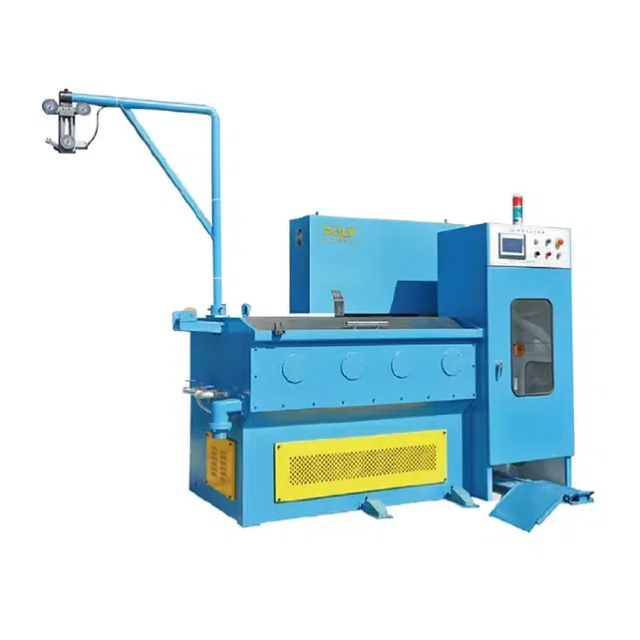
Dies are at the heart of every wire drawing machine. Whether made of tungsten carbide, polycrystalline diamond, or natural diamond, they experience significant wear under high pressure. Die life is influenced by the hardness of the drawn material, lubrication quality, and reduction schedule. Frequent replacement or re-polishing adds cost and downtime. For high-volume production, these maintenance cycles must be carefully balanced against throughput requirements.
To extend die life, companies often invest in die management systems and automated lubrication. Yet even with the best systems, maintenance costs remain a significant part of the wire drawing budget, making it a limitation managers cannot ignore.
Beyond dies, the mechanical design of the wire drawing machine itself creates boundaries. Each machine has a finite stroke length, capstan pulling capacity, and tension control range. Attempting reductions beyond machine ratings risks wire breaks or equipment failure. For extremely fine wires, tension must be precisely controlled to avoid stretching or snapping.
Modern machines now integrate digital tension monitoring, automatic capstan adjustment, and safety stops to reduce risk. However, these upgrades increase the initial investment, and small-scale producers may not find it economical. Therefore, equipment limits often translate into strategic decisions about whether to outsource ultra-fine wire production or invest in specialized machines.
When strain hardening exceeds ductility limits, intermediate annealing becomes unavoidable. While annealing restores the wire’s ability to deform, it slows throughput and increases energy costs. This requirement can make large-diameter reductions less efficient, especially for high-strength alloys. In some cases, annealing steps may represent the majority of process time, limiting economic competitiveness.
The challenge is that intermediate annealing cannot be avoided if product reliability is a priority. Skipping it may reduce costs in the short term but creates risks of cracks and failures later in service. For industries like aerospace and medical, annealing is non-negotiable, even if it reduces throughput.
Wire drawing is a balance between speed and quality. Aggressive reduction schedules allow fewer passes but risk surface roughness, internal micro-cracks, or poor dimensional control. On the other hand, conservative reductions produce higher quality but increase cycle time. This trade-off is at the core of process planning: how much speed can be gained without compromising ductility, finish, or end-use performance?
For large-scale operations, optimization software is now used to simulate reduction schedules and predict outcomes. However, even with advanced planning, there remains a fundamental limit—no process can deliver maximum speed, minimum cost, and perfect quality simultaneously. Choices must be made based on customer priorities and product application.
Lubricants are essential to wire drawing, but they also introduce disposal and environmental challenges. Regulations vary by region, but many manufacturers face stricter limits on waste oil and soap-based lubricants. Meeting compliance requires investment in waste treatment or lubricant recycling systems. Additionally, the choice of lubricants can impact surface quality, making it a dual technical and environmental limitation.
As sustainability goals become more important, many companies are exploring water-based or dry lubricants. These alternatives reduce environmental impact but are not yet universally applicable, particularly for high-strength wires.
The performance of a wire drawing machine is only as good as the inputs. Low-quality rods with surface defects can cause breakage, while poor die materials wear quickly and compromise product quality. In many regions, sourcing high-purity copper rods or fine diamond dies depends on global supply chains, which may be disrupted by logistics or trade policy.
Supply chain constraints also extend to spare parts and consumables. A well-designed production plan always includes reliable partnerships with suppliers. At Zhangjiagang Poly, we emphasize not only machine performance but also long-term supply chain support to help customers minimize these risks.
Wire drawing remains an indispensable process for producing wire across industries, from power cables to precision electronics. But it is not without its boundaries—metallurgical, geometric, mechanical, and economic. At Zhangjiagang Poly Machinery and Electric Manufacturing Co., Ltd., we design and manufacture wire drawing machines that maximize productivity while helping our customers navigate these very limitations. Whether planning to draw in-house or sourcing pre-drawn wire, understanding these constraints is the first step toward making the right decision for your business. For more details or to discuss the best solution for your production, please contact us today.



 English
 简体中文
简体中文

