
- Home
- Products
- Company
- Solutions
- Advantages
- Blog
- Contact
- Hot
Views: 0 Author: Site Editor Publish Time: 2026-10-14 Origin: Site


High-speed continuous copper wire manufacturing faces a demanding core challenge. You must achieve consistent metallurgical properties, specifically grain recrystallization, without sacrificing line speeds. Bottom-line profitability in wire production hinges entirely on minimizing scrap rates. Brittle wire causes poor elongation. Surface discoloration indicates oxidation. Both issues destroy yields and impact operational efficiency.
This article provides process engineers and plant managers a rigorous, evidence-based framework. You will learn how to evaluate inline annealing equipment effectively. We outline how to establish strict quality checks and mitigate common implementation risks. Mastering copper wire inline annealing quality ensures your production lines run flawlessly at maximum design speeds, protecting your margins from avoidable waste.
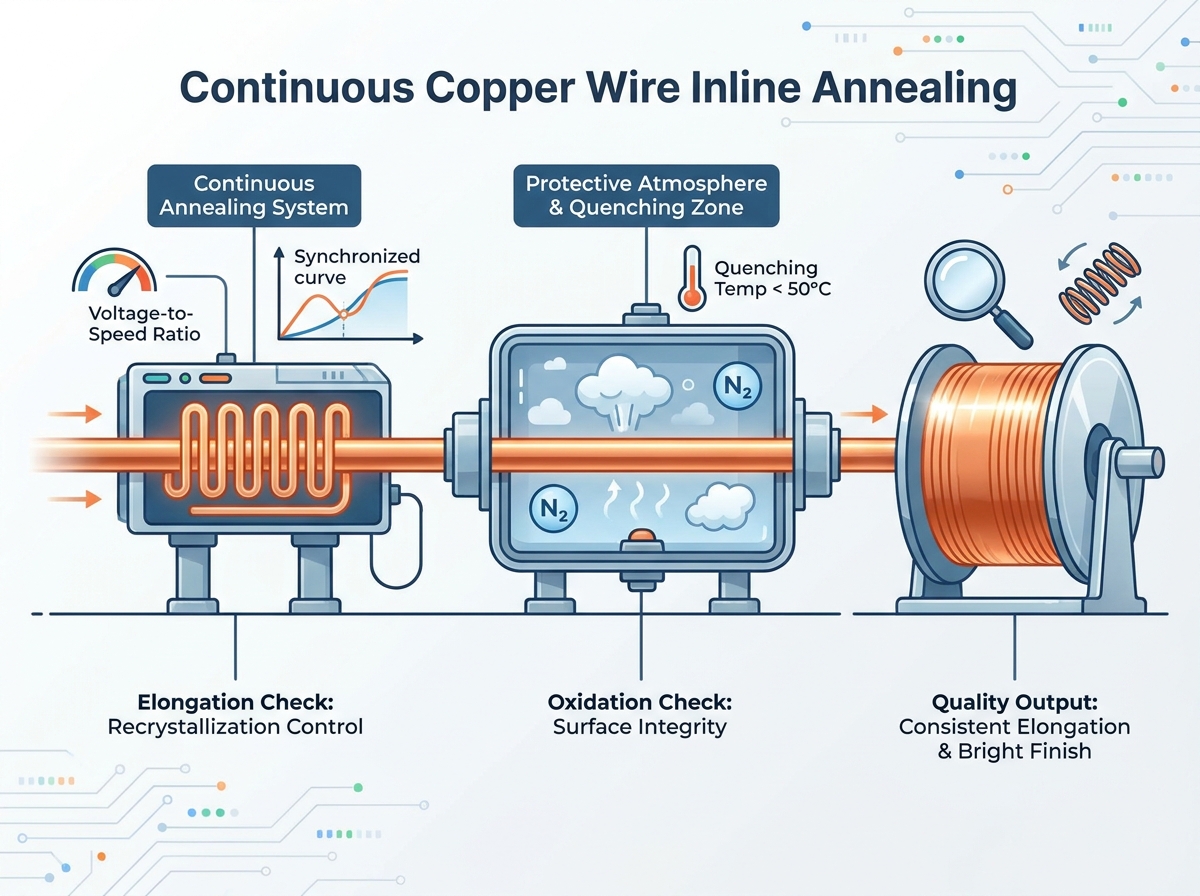
Targeted Elongation Variables: Precise synchronization of annealing voltage to line speed is the primary driver of consistent elongation in continuous annealing systems.
Oxidation Prevention: Effective oxidation control relies entirely on the integrity of the protective atmosphere (steam or nitrogen) and the exact temperature management of the quenching fluid.
Equipment Evaluation: When selecting a continuous annealing wire drawing machine, prioritize closed-loop feedback systems that automatically adjust thermal input based on real-time speed data.
Material Nuances: Cu-ETP (Electrolytic Tough Pitch) and Cu-OF (Oxygen-Free) copper require distinct annealing curves and operational baselines to prevent hydrogen embrittlement or incomplete recrystallization.
Inline annealing connects wire drawing and spooling into a single continuous process. This integration creates significant efficiency gains. However, it also introduces substantial risk. A failure in annealing quality instantly generates thousands of meters of non-compliant scrap. By the time an operator notices a visual defect, the spool is often already ruined. You cannot easily salvage this material. It must go back to the furnace, wasting energy, time, and raw materials.
Defective annealing triggers a cascade of downstream failures. We classify these failures into two main categories:
Elongation failures: Brittle wire snaps under tension. This leads to severe wire breakage during subsequent stranding, bunching, or extrusion processes. Each break causes costly machine downtime and requires manual re-threading.
Oxidation failures: Surface oxidation ruins the copper's surface energy. This results in poor adhesion of polymer insulation materials. It also increases electrical resistance. End-users will ultimately reject the cable due to cosmetic blemishes or functional degradation.
A successfully optimized line meets strict quantitative benchmarks. It achieves greater than 25-30% elongation, depending on the specific wire gauge. The copper exits the machine sporting a bright, mirror-like surface finish. Crucially, the system achieves this at maximum design speeds. Quality control teams should expect the process to maintain a Cpk (Process Capability Index) of greater than 1.33. This statistical metric confirms the annealing process remains highly capable and tightly controlled.
Process engineers must establish clear baseline metrics. You base these targets on wire diameter and the specific copper grade. Manufacturers primarily process Cu-ETP (Electrolytic Tough Pitch) and Cu-OF (Oxygen-Free) copper. These materials behave differently under heat. Cu-OF typically features a lower recrystallization temperature. Operators must apply different thermal profiles to avoid damaging the crystalline structure.
Copper Grade | Oxygen Content | Recrystallization Profile | Common Risks |
|---|---|---|---|
Cu-ETP | Typical 150-400 ppm | Higher temp required | Hydrogen embrittlement if exposed to reducing gases |
Cu-OF | < 10 ppm | Lower temp required | Grain growth irregularities if over-annealed |
The annealing curve defines the critical relationship between electrical power and mechanical speed. Thermal energy input must perfectly match the mass flow rate of the copper wire. If the line speeds up, the voltage must increase proportionally.
Errors in this ratio produce immediate defects. Over-annealing pushes too much heat into the wire. This results in "sticky" wire stretching excessively under tension. It often necks down, altering the final diameter. Conversely, under-annealing leaves the wire hard and brittle. It fails to recrystallize fully, retaining the mechanical stresses generated during drawing.
Relying solely on visual checks invites disaster. Facilities must implement standardized testing protocols to verify mechanical softness.
Tensile Testing: Execute formal tensile testing following standards like ASTM B258 or B1. Extract physical samples at the beginning, middle, and end of spool runs. This verifies consistency across the entire batch.
The Springback Test: Assess the "springback" test as a quick, shop-floor diagnostic tool. Operators wind a wire sample tightly around a mandrel, then release it. A dead-soft, perfectly annealed wire exhibits minimal uncoiling. A stiff wire springs back aggressively, indicating incomplete recrystallization.
Best Practice: Log springback angles digitally. Tracking this data helps engineers identify slow-drifting calibration errors in the annealing voltage.
Copper oxidizes rapidly when exposed to oxygen at elevated temperatures. To prevent this, equipment manufacturers utilize protective atmospheres. Evaluate the standard use of steam as a protective barrier inside the annealing tube. Steam effectively displaces ambient oxygen. It shields the hot copper wire during the critical heating phase.
Engineers must monitor several common failure points in the steam system:
Insufficient steam pressure: Low pressure allows ambient air to infiltrate the heating chamber.
Wet steam: Excessive condensate in the steam line causes water spotting on the hot wire surface.
Die wear: Worn entry or exit dies permit unwanted air ingress, compromising the entire inert zone.
Heating the wire represents only half the process. The cooling phase dictates final surface quality. The wire must cool below its oxidation threshold before exiting the protective atmosphere. For copper, this threshold sits typically below 50°C.
Discuss the crucial role of the cooling fluid. Maintaining a stable fluid temperature requires high heat exchanger efficiency. If the fluid runs too hot, it cannot quench the wire quickly enough. Operators must also manage the concentration of anti-oxidation additives in the bath. Furthermore, strict filtration requirements prevent copper dust buildup. Suspended copper particles scratch the wire surface and degrade the quenching fluid's thermal capacity.
Quality control relies on dual inspection methods to catch oxidation early.
Visual standards: Inspectors perform brightness and color consistency checks. Healthy wire looks bright and reflective. Dull pink, red, or purple hues indicate distinct levels of oxide formation.
Chemical tests: Facilities utilize polysulfide testing to detect micro-oxidation. You submerge a sample into a sodium polysulfide solution. Unseen oxide layers react and turn black instantly. This chemical diagnostic catches failures not immediately visible to the naked eye.
When upgrading a facility, evaluating heating methods forms the foundation of your strategy.
DC/AC Resistance Annealing: This remains the industry standard for most wire gauges. The machine passes electrical current directly through the wire via contact pulleys. While highly efficient, you must continuously evaluate contact band wear. Degraded bands cause electrical arcing. Arcing creates severe surface pitting on the finished wire.
Induction Annealing: This offers contactless heating. The wire passes through an electromagnetic coil. Evaluate this method for premium applications requiring zero surface marring. Since nothing touches the hot wire, surface defects drop dramatically. However, capital expenditure (CapEx) for induction systems typically runs higher than resistance models.
You cannot achieve steady elongation manually. When shortlisting a continuous annealing wire drawing machine, mandate PLC-driven closed-loop controls. The system reads real-time speed data from line encoders. It autonomously adjusts the annealing current during line acceleration and deceleration. If the machine slows down unexpectedly, the PLC instantly drops the voltage. This prevents hard spots or melted wire segments.
Look past the software and evaluate the physical hardware. Investing in advanced continuous annealing technology for copper wire requires analyzing mechanical durability. Look for multi-zone cooling systems offering graded temperature drops. Ensure the machine uses durable ceramic or carbon contact rings rather than standard steel. Finally, inspect the integrated air-wipes. These pneumatic devices must effectively strip residual moisture from the wire before it reaches the take-up spool. Wet wire corrodes rapidly in storage.
Common Mistake: Neglecting air-wipe pressure. If operators lower the air pressure to reduce plant noise, moisture carries over onto the spool, ruining the entire batch over the following weeks.
Plant managers often debate retrofitting old lines versus installing new equipment. Assess the complexity of integrating a modern continuous annealer into an older wire drawing line. Legacy PLCs may lack the processing speed required for accurate voltage-to-speed tracking. If the old drawing machine accelerates irregularly, the new annealer will struggle to match the heat input. A greenfield installation avoids these mismatched communication protocols.
Annealing equipment demands rigorous upkeep. Acknowledge that contact pulleys degrade over time. The constant friction of copper wire cuts deep grooves into the nickel or carbon bands. Outline a mandatory preventative maintenance schedule. Maintenance teams must commit to turning or replacing contact bands regularly. Failing to maintain these bands destroys electrical efficiency and ruins wire surfaces.
Advanced technology often intimidates veteran operators. Address the significant risk of operator override. When facing unexpected wire breaks, operators might panic and switch the PLC to manual mode. They attempt to adjust voltages by feel. Train personnel comprehensively. They must rely on the programmed annealing curves. Manual voltage adjustments introduce profound human error and guarantee batch variability.
Achieving flawless wire production requires treating annealing as a precise science rather than a black-box process. Consistent elongation and zero oxidation remain non-negotiable benchmarks for modern wire manufacturing. Equipment design dictates your success ceiling.
Investing in advanced continuous annealing systems featuring robust steam loop management and closed-loop electrical controls provides the most reliable path to reducing scrap. This technology actively protects your margins. Do not accept vague performance promises from vendors. We recommend a proactive next step: request specific Cpk data and demand trial run guarantees from equipment manufacturers using your facility's exact copper rod stock. This evidence-based approach ensures your final installation performs flawlessly under real-world factory conditions.
A: Best practice dictates testing at every spool changeover, or continuously via inline tension-monitoring sensors, to ensure the annealing curve remains calibrated.
A: Discoloration indicates surface oxidation, typically caused by a compromised protective steam atmosphere, air leaks in the cooling tube, or the wire exiting the quench zone at too high a temperature (above 50°C).
A: Yes, but operators must switch to specific, pre-programmed annealing curves in the PLC, as Cu-OF requires different thermal energy inputs for optimal recrystallization compared to Cu-ETP.
A: This is usually a failure in the synchronization between line speed and annealing voltage. Older or poorly tuned machines struggle to modulate power fast enough during acceleration, leading to under-annealed (hard) segments.



 English
 简体中文


